About the project

Our project

Showing posts with label 1930s. Show all posts

Monday, 28 April 2025

Tom Kay to Derbyshire

 By Elizabeth Kay

So why did my dad Tom Kay leave Cumnock? The answer is simple. As, in lots of cases, work. 

Born in 1901 (Tom not Thomas, on his birth certificate) in Spout Row, in Ayr Road, he was the eldest of three having two younger sisters, Nannie Kay, the Cumnock librarian and Mrs Jean Smith. He attended school in Cumnock then night school in Ayr. I remember seeing an attendance record for night school and remarking it wasn't very good, only to be told he and his pals could only go if they had the bus fare. Sometimes he walked part of the way. Dad did his five year apprenticeship as a fitter at Drummonds in Cumnock ending on 31st December 1920. He also worked for Montgomery and Howat. Under the 1921 census he was a postman, something he did off and on over a period of around 15 years. 


He did spend time in Glasgow working for, among others, John Brown's shipyard in the 1930s. Of course, we all know what happened to the 534 when work stopped in 1931, due to lack of funds. He did return to Glasgow when work restarted and saw the launch of the Queen Mary on the 26th of September 1934. I still have the ticket, below. The name of the vessel wasn't known until the actual launch by Queen Mary.  I also have references from Montgomery and Howat and the Post Office dated 1935. 


But no other work being available, when in the Cumnock Labour Exchange the following happened. He saw jobs were available for his trade as a fitter in England. Reading this from his side of the counter, he said to the clerk pointing “I wouldn't mind going there” she said OK and filled in the chit. When he read it, the work was in Spondon. He thought it said “London”!  So that is how he came to Spondon, a suburb of Derby in the English Midlands. 

Getting off the train outside the factory, he went in for an interview and got a job. He then walked up into the village of Spondon to find digs. He found some very soon. After working at British Celanese (a chemical company) for around a year.

British Celanese, now demolished.  geograph


He saw a job advertised in London, so he did get to London working as a fitter for a small firm in Euston Rd. He loved London. The highlight of his stay was the coronation of George  VI in 1937. When it became clear war was coming, he decided to return to Derby (Derby never had unemployment problems, having many industries) and got a job at Rolls Royce. He spent World War II working on Merlin engines. Amongst his workmates he met a man who was a member of a local rambling club, "would my dad like to come along?" Well, he was always fond of walking and the countryside, so he became a member and that was where he met my mum, Mabel.

They married in 1941. He first took her to Cumnock in 1940 to show her his birthplace (she came very familiar with Cumnock) and to meet this family. His mother told him never to take Mabel away from her mother, so no more moving about. When I came along after the war, he was still at Rolls Royce but they soon let go the extra folk taken on for the war. 

What to do next? Well, he went back to British Celanese at Spondon as they were taking on fitters. I should explain here, that British Celanese was not just one factory. It was a huge site employing around 20,000 people at any one time with departments for spinning, weaving, dyeing, printing artificial silk. Ever heard of Tri-cel ? They made 90% of the ether used in Britain in the 1950s and yes there was a stink, a pong or as it was known around here the “Spondon Hum”! It was opened in 1916 for the manufacture of cellulose acetate dope for World War One aircraft. It closed in 2015.

Well, when he went back for another job and they looked up his cards they asked is this your address 37 Ayr Road Cumnock? No, he said, "not anymore" and gave his new address. He worked there until his retirement in 1966 having spent the last 10 years as a “time and motion” man and estimator, a cleaner job. 


We spent most of our holidays in Cumnock -  as a child I was taken every year. One visit that I remember was the summer of 1966. As a young man he entered the Flower Show in Cumnock. Often I found reports in the Cumnock Chronicle of shows he entered in the 1920s and 30s and in 1966 he wanted another shot. He was very fond of his roses so we packed up cut roses on the Friday evening in a large cardboard box. They sat in tubes of water with cotton wool. We caught the midnight train from Derby to Kirkconnell, Cumnock station having closed. Then a bus, a double decker Western SMT to Cumnock Town Hall where he took the roses straight in to stage them. He was thrilled to be among the prizes-winners once again. We returned home by coach on Sunday morning and back to work on Monday. 

flower shows 1926

As a child he took me out on walks in Cumnock but always stopped to talk to someone having been a postie, I think he knew half the toon! His last visit was the summer of 1969 just a few months before he died. Keeping up with current news was easy as his sister sent him the Chronicle every week along with the Ayrshire Post, a football paper and a couple of others. I was quite used to his Scottish accent but it was much stronger when he was amongst his “ain folk”. Before his mother died in 1943, he always had to have his train fare home in the Post Office.

Elizabeth still lives in Spondon.


Tuesday, 26 December 2023

The family of John Goldie, draper

 by Roberta McGee

John Goldie was born in 1858 in Catrine, the eldest son of Andrew Goldie, a weaving master with Messrs James Findlay & Co., Catrine and Agnes Kennedy, a power loom weaver. He served his time in the drapery trade in Glasgow where he formed a life-long friendship with The Hon. George Fowlds who became Minister of Education in New Zealand. In 1881 John took over the drapery business in Lugar Street, Cumnock from John Baird, the donor and founder of the Baird Institute. That same year, on 27th December, he married Margaret Dunlop in Catrine. 

John and Margaret soon became very much part of the community in Cumnock, being closely involved in the United Free Church, West and both becoming Justices of the Peace. Sixteen years later John acquired the house at the Hamilton Place corner of The Square and he transformed the building, adapting it to his rapidly extending business as a draper, ladies' & gent's outfitter etc. and there he remained, actively engaged, almost to his death. John died in 1939 at 9 Herdston Place, Cumnock. He was 80 years old. His wife Margaret died in 1951 in Cape Town, Cape Province, South Africa, the home of her daughter Catherine. She was 92 years old. 


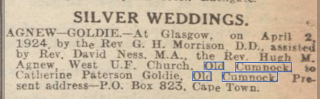
Cumnock Chronicle 1924


Goldie’s shop with canopy. It was extended round the corner into Hamilton Place.


The first of John & Margaret Goldie's surviving children was Catherine Paterson Goldie who was born in 1885 in Cumnock and died in 1964 at Port Elizabeth, Natal, South Africa. Catherine married the Rev. Hugh Agnew, Minister of The United Free Church, West, Cumnock, in Glasgow in 1924. Hugh had been ordained in 1922 and met Catherine through her family's close connections with the church. She was eight years older than Hugh. 

Silver Wedding Announcement 1949 - from Cumnock Connections Tree

Rev. Hugh Agnew served The United Free Church, West, from 1922 - 1930 and wrote 'The United Free Church West, Cumnock's History 1773 - 1923, published in 1923 by The Cumnock Chronicle Press. The box shaped church is the oldest church building left in Cumnock. After being a council storage facility it stood derelict for some years before being turned into The Box Cafe.


United Free Church West


Rev. Hugh Agnew sitting beside his father-in-law John Goldie


In 1929 Catherine and Hugh moved to Dundee where Hugh served as Minister at St. David's North Church until 1933 when they decided to emigrate to South Africa. His first charge in South Africa was St. George's Church, East London. 

The lives of the natives were most un-Christian. Not surprising conditions considering the hovels they were living in"
Rev. Hugh Agnew

Hugh took action. He managed to persuade the South African Minister of Finance to visit the place and the outcome was that he secured a £12 million project for the abolition of some of South Africa's most squalid slums. Medical schemes were set up and new locations, complete with water systems and other modern fittings, were built. His final charge was as Minister of St. Andrew's Presbyterian Church in Cape Town. This church had been formed by a detachment of Cameron Highlanders stationed at Cape Town in 1828 after financial grants had been received from the Dutch Reform Church and German Lutheran Church.

Catherine and Hugh did manage to visit Cumnock again a few times accompanied by their sons Hugh, who had been born in Cumnock and became a gynaecologist in South Africa and Ian, who had been born in Forfar, Scotland. Like Catherine, Rev. Hugh also died in South Africa.

Obituary 1/11/1957 - Dundee Obituary Books findmypast 1869 - 2018
Rev. Hugh M. Agnew, popular minister of St. David's North Church, Dundee from 1929-1933, when he went to South Africa, has died in East London, South Africa. He was 64. In South Africa he had been a minister in East London & Port Elizabeth and was General Secretary of  the Presbyterian Church of South Africa before re-entering the pastoral charge of St. Andrew's, Cape Town. He became Moderator of the Presbyterian Church of South Africa. While he held the position, four years ago he represented the South African Church at the General Assembly of the Church of Scotland. He revisited Dundee at that time. A friend of the late General Smuts, he instigated a £12 million project for the abolition of some of South Africa's most squalid slums.

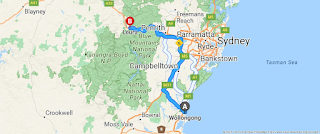
John and Margaret's second child was Robert Dunlop Goldie who was born in 1887 in Cumnock. He attended the Universities of Edinburgh and Cambridge and graduated M.B., Ch.B. and D.P.H., after which he began work as House Physician and House Surgeon at Glasgow Royal Infirmary. He emigrated to Australia in 1912 and commenced practice in Scarborough, Australia. At the beginning of WW1 in 1914 he enlisted with the Royal Army Medical Corps RAF and left with one of the first contingents of military reservists. He was promoted to Major and was awarded the French Honour, Medaille d’Honneur des Epidemies. On his return to Australia after WW1 he commenced practice at Corrimal, which is a suburb of Wollongong, New South Wales and in 1929 he commenced practice at Wollongong. During his very successful career in Australia Robert served as Commonwealth & State Medical Officers. Robert married Margaret (Daisy) Sellers in 1920 in Sydney and they went on to have four children. He died suddenly in 1952 while on holiday at Leura in the Blue Mountains in New South Wales. He named his house in Wollongong Glaisnock.


Leura and Wollongong, New South Wales


The third child of John & Margaret Goldie was Andrew who was born in 1889 in Cumnock and died in 1947 at 2 McCall Avenue, Cumnock. Andrew was the only one of their children to remain in Cumnock. He followed his father into the drapery trade and worked alongside him in the shop. Andrew married Janet Murdoch Gardiner in 1915 at Blythswood, Glasgow. Janet was born in 1881 in Auchinleck and died in 1965 at 2 McCall Avenue, Cumnock. 

Andrew and Janet had one son, John Dunlop Goldie who was born in 1920 in Cumnock. John, who was known as Jack, was a spitfire pilot in WW2. He was a sergeant with 542 Squadron, Royal Air Force Volunteers and was killed in action 26/1/1943 while on a photo recce sortie to Ghent, Belgium. Jack is buried at Eeklo Communal Cemetery, Belgium. He had only been married a short time when he was killed.

Fourth child John Kennedy Goldie (Kenny) was born in 1893 in Lugar Street, Cumnock. Kenny didn't keep good health and in 1913 he decided to emigrate to New Zealand in the hope that the milder climate would improve his condition. He managed to find employment as a warehouseman in Newmarket, a suburb of Auckland, New Zealand. WW1 was declared and in 1915 Kenny enlisted with the New Zealand Expeditionary Force, 2nd Battalion, Otago 9th Infantry Regiment. He was sent on active service to Egypt then France. His health worsened and in December 1916 he was admitted to hospital where he was diagnosed with tuberculosis. He was permanently discharged on 22nd December 1917.  The reason given was that he was no longer physically fit for war service because of a pre-enlistment disability aggravated by active service. On discharge he was recommended for a pension as his capacity for earning was only one half.

Records show that Kenny suffered from this condition pre-enlistment so it's surprising that he was accepted as a soldier. Tuberculosis caused breathing difficulties among other things. Chlorine gas was used for the first time by the Germans in 1915. When inhaled it caused soldiers to have difficulty breathing and sometimes death. Before gas masks were distributed soldiers would soak cloth in urine and hold it to their faces to prevent them from breathing in the gas. 

In 1919 Kenny married Lucy Mabel Booth but sadly he had a short life and died in 1925 in Auckland, New Zealand.

The youngest child of John and Margaret was Hugh Dunlop Goldie who was born in 1897 in The Square, Cumnock. Hugh served his apprenticeship as an engineer & fitter with George McCartney & Co. in Cumnock before enlisting with the Queen's Own Cameron Highlanders in 1914. He saw active service in Salonika where he contracted malarial and rheumatic fever. He was invalided out and returned to Cumnock where he was employed as a motor engineer by Messrs. H.D. Hunter. In 1922 he emigrated to Auckland, New Zealand to join his brother Kenny who had tuberculosis. Kenny died in 1925 and in 1935 Hugh left New Zealand for East London, South Africa, where his sister Catherine and her family lived. Unfortunately Hugh had a recurrence of the old rheumatic fever and died in 1939 at Frere Hospital, East London, South Africa.