About the project

Our project

Showing posts with label drapers. Show all posts

Friday, 15 August 2025

Scotch Drapers in Liverpool

By Elaine Corbett

This is a story of a family sticking together and helping out with motherless and orphaned nieces and nephews.

Two Sloans (children of Peter Sloan and Mary Gall of Roughside and Knockterra) married two McMillan siblings (born in Minnigaff). 

First Alexander Sloan married Jeannie McMillan in Liverpool in 1880 and then in 1882  his sister Margaret Sloan married Jeannie’s brother James McMillan at Knockterra. Both men were drapers in Liverpool. Jeannie was already dead by the time of her brother's  wedding in 1882 , leaving a baby Peter Sloan.

Margaret Sloan

Alexander and Jeannie are in the census of 1881 at 9 Brownlow Street, Liverpool. He is a travelling draper age 28. Travelling drapers went from place to place selling items from a pack.

Other household members are baby Peter Sloan, and a three-year-old niece Elizabeth (Lizzie) Susan Clive.       Lizzie was the daughter of Jeannie’s sister Margaret McMillan who had died in January 1878, aged 40, three months after the birth of Lizzie.  Her widowed father a mason in Old Luce was looking after her brothers, while another sister was with their Aunt and Uncle on a farm in Old Luce.    

Ten years on in the 1891 census James McMillan and Margaret (Sloan) are living at 16 Brownlow St. along with Alexander, Lizzie Clive, and Peter Sloan,  as Jeannie had died in November 1881 when her son Peter was only 9 months old.

As well as the McMillan/Sloans, Brownlow St. appears to have several families in the drapery trade in 1891. They are:

Caroline Bentham draper’s Assistant aged 20,

William Alexander draper aged 45 (from Auchinleck) on Cumnock Connections tree

Mary Mitchell Alexander wife aged 43 (from Tarbolton)

Robert Alexander aged 19 assistant draper

Samuel Mitchell aged 29 draper

James Warrener aged 71 draper (from Pudsey)

Thomas Pagan aged 42 (from Scotland)

Jane his wife aged 37 (from Scotland)

William Morgan aged 45 Draper

William Rae aged 45 draper (from Scotland)


Two years later Peter’s father died, and Peter, at the tender age of 12, continued to live with his aunt and uncle.

In the 1901 census, the McMillan sons are listed as being school age, but Peter Sloan, aged 20 is a civil engineer. His cousins would later be taken into the family business that seems to have gone from strength to strength. Peter chose a very different path.

By the time of the census in 1911, the only drapers on Brownlow St. are the McMillans.

The 1921 census refers to the McMillans as ‘credit drapers’. This means that they sold goods ‘on tick’, payment in instalments with a premium added. Usually aimed at people in the poorer income bracket, some sales could make 100% profit for the draper. It was an early example of the credit card, and not universally approved of, being seen as temptation to the spendthrifts of the lower classes. The company was referred to as McMillan and Sons. James McMillan died at Wh

The term ‘Scotch Drapers’ refers to the travelling salesmen, who although in the early days had been predominantly Scots, they then evolved into drapery businesses employing travelling salesmen working on their own account, and from more diverse ethnic groups. The salesmen had to pay into the business, and act as tallymen, collecting dues from customers who bought goods ‘on tick’.

Peter Sloan however had received his education at the Liverpool Institute and served his apprenticeship with Messrs C. S. Wilson & Co of Regent Road, Bootle. He joined the White Star Line two weeks after the completion of his apprenticeship and served on various vessels both in the Atlantic and Mediterranean routes. He was shown serving as an electrician aboard the Cretic in October 1905, his ship prior to that being stated as the Celtic; at this time his address was listed as 103 Vine St. Liverpool.

Peter married Annie Blair, a Belfast girl, in August 1908 and they set up home together in 14 Newcastle Rd. Wavertree, Liverpool. Peter was a Marine Electrical Engineer by this time.

A year later Peter had risen to the position of Chief Electrician. It must have been with great enthusiasm that he signed up for his next assignment in Southampton.

Peter Sloan

The ship he signed up to was RMS Titanic

In April 1912, Peter set sail from Southampton, leaving Annie in Liverpool. They had no children. He was part of the crew that kept the ship’s lights and systems running.

When the Titanic hit the iceberg, electricians like Peter were among the heroes who stayed at their posts to keep the lights on so passengers could see to escape.

Peter Sloan’s body was never recovered, but his story became part of Titanic history — a reminder that sometimes the greatest legacies aren’t in money or business, but in courage.


Monday, 15 January 2024

Drapers

By Kay McMeekin

When doing our recent farm research,  we noticed that many farmers sons were becoming drapers particularly in England.

There were travelling drapers as well as shop workers.

A draper sold cloth and was often an outfitter as well. 

The definition of “Scotch Draper” was someone who sold goods door to door with payments to be made in instalments. They were also known as travelling drapers and credit drapers. (from https://www.cottontown.org/Other%20Industry/Pages/Retail-Trade.aspx)


Dumfries and Galloway Standard - Wednesday 17 January 1877


Ayr Advertiser 1883

John Weir 1836-1890 of Sykeside farm Cumnock was a draper in Rotherham, Yorkshire

William Howat of Polquhirter and brothers David and James were drapers in Preston, Lancashire in 1881.

Three Baird of Watson sons went to Lancashire, and Robert Baird's brothers-in-law John and Matthew McKerrow were also drapers in Lancashire.

Another related line of McKerrows were drapers William McKerrow in Wigan and Ormskirk.


Banffshire Herald - Saturday 16 July 1898


This article from the Western Mail - Wednesday 02 April 1930 throws some light on the situation.

DRAPERY TRADE. 
HOW TO ATTRACT THE BEST RECRUITS. 
Sir Sydney Skinner, president of the Drapers' Chamber of Trade, presiding at the annual meeting of the chamber at the Cordwainers' hall, Cannon Street, on Tuesday, said stressing the need for attracting the right sort of ability to the drapery trade, 
"In the old days we used to get the sons and daughters of farmers. A farmer always used to put a boy or girl into the drapery trade. Some of the must successful men and women we have in our business to-day are farmers' sons and daughters. We do not get so many now, and I believe this is largely due to the fact that mothers to-day have a fear of sending their daughters to the big towns. I myself am reinstating the 'living-in' system, because I am going to try and re-attract that type of boy and girl. I ant not going to let them come to London and be at the mercy of some woman who runs a lodging-house and will fleece them. It is because the 'living in' system has been abolished that many mothers are no longer sending us their girls. The drapery trade gives a boy or girl coming up from the country a wonderful opportunity for progress such as very few other trades or professions will offer them."

Tuesday, 26 December 2023

The family of John Goldie, draper

 by Roberta McGee

John Goldie was born in 1858 in Catrine, the eldest son of Andrew Goldie, a weaving master with Messrs James Findlay & Co., Catrine and Agnes Kennedy, a power loom weaver. He served his time in the drapery trade in Glasgow where he formed a life-long friendship with The Hon. George Fowlds who became Minister of Education in New Zealand. In 1881 John took over the drapery business in Lugar Street, Cumnock from John Baird, the donor and founder of the Baird Institute. That same year, on 27th December, he married Margaret Dunlop in Catrine. 

John and Margaret soon became very much part of the community in Cumnock, being closely involved in the United Free Church, West and both becoming Justices of the Peace. Sixteen years later John acquired the house at the Hamilton Place corner of The Square and he transformed the building, adapting it to his rapidly extending business as a draper, ladies' & gent's outfitter etc. and there he remained, actively engaged, almost to his death. John died in 1939 at 9 Herdston Place, Cumnock. He was 80 years old. His wife Margaret died in 1951 in Cape Town, Cape Province, South Africa, the home of her daughter Catherine. She was 92 years old. 


Cumnock Chronicle 1924


Goldie’s shop with canopy. It was extended round the corner into Hamilton Place.


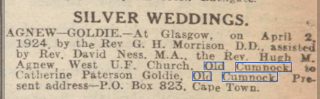
The first of John & Margaret Goldie's surviving children was Catherine Paterson Goldie who was born in 1885 in Cumnock and died in 1964 at Port Elizabeth, Natal, South Africa. Catherine married the Rev. Hugh Agnew, Minister of The United Free Church, West, Cumnock, in Glasgow in 1924. Hugh had been ordained in 1922 and met Catherine through her family's close connections with the church. She was eight years older than Hugh. 

Silver Wedding Announcement 1949 - from Cumnock Connections Tree

Rev. Hugh Agnew served The United Free Church, West, from 1922 - 1930 and wrote 'The United Free Church West, Cumnock's History 1773 - 1923, published in 1923 by The Cumnock Chronicle Press. The box shaped church is the oldest church building left in Cumnock. After being a council storage facility it stood derelict for some years before being turned into The Box Cafe.


United Free Church West


Rev. Hugh Agnew sitting beside his father-in-law John Goldie


In 1929 Catherine and Hugh moved to Dundee where Hugh served as Minister at St. David's North Church until 1933 when they decided to emigrate to South Africa. His first charge in South Africa was St. George's Church, East London. 

The lives of the natives were most un-Christian. Not surprising conditions considering the hovels they were living in"
Rev. Hugh Agnew

Hugh took action. He managed to persuade the South African Minister of Finance to visit the place and the outcome was that he secured a £12 million project for the abolition of some of South Africa's most squalid slums. Medical schemes were set up and new locations, complete with water systems and other modern fittings, were built. His final charge was as Minister of St. Andrew's Presbyterian Church in Cape Town. This church had been formed by a detachment of Cameron Highlanders stationed at Cape Town in 1828 after financial grants had been received from the Dutch Reform Church and German Lutheran Church.

Catherine and Hugh did manage to visit Cumnock again a few times accompanied by their sons Hugh, who had been born in Cumnock and became a gynaecologist in South Africa and Ian, who had been born in Forfar, Scotland. Like Catherine, Rev. Hugh also died in South Africa.

Obituary 1/11/1957 - Dundee Obituary Books findmypast 1869 - 2018
Rev. Hugh M. Agnew, popular minister of St. David's North Church, Dundee from 1929-1933, when he went to South Africa, has died in East London, South Africa. He was 64. In South Africa he had been a minister in East London & Port Elizabeth and was General Secretary of  the Presbyterian Church of South Africa before re-entering the pastoral charge of St. Andrew's, Cape Town. He became Moderator of the Presbyterian Church of South Africa. While he held the position, four years ago he represented the South African Church at the General Assembly of the Church of Scotland. He revisited Dundee at that time. A friend of the late General Smuts, he instigated a £12 million project for the abolition of some of South Africa's most squalid slums.

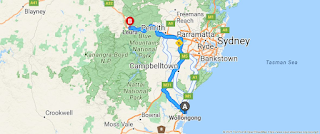
John and Margaret's second child was Robert Dunlop Goldie who was born in 1887 in Cumnock. He attended the Universities of Edinburgh and Cambridge and graduated M.B., Ch.B. and D.P.H., after which he began work as House Physician and House Surgeon at Glasgow Royal Infirmary. He emigrated to Australia in 1912 and commenced practice in Scarborough, Australia. At the beginning of WW1 in 1914 he enlisted with the Royal Army Medical Corps RAF and left with one of the first contingents of military reservists. He was promoted to Major and was awarded the French Honour, Medaille d’Honneur des Epidemies. On his return to Australia after WW1 he commenced practice at Corrimal, which is a suburb of Wollongong, New South Wales and in 1929 he commenced practice at Wollongong. During his very successful career in Australia Robert served as Commonwealth & State Medical Officers. Robert married Margaret (Daisy) Sellers in 1920 in Sydney and they went on to have four children. He died suddenly in 1952 while on holiday at Leura in the Blue Mountains in New South Wales. He named his house in Wollongong Glaisnock.


Leura and Wollongong, New South Wales


The third child of John & Margaret Goldie was Andrew who was born in 1889 in Cumnock and died in 1947 at 2 McCall Avenue, Cumnock. Andrew was the only one of their children to remain in Cumnock. He followed his father into the drapery trade and worked alongside him in the shop. Andrew married Janet Murdoch Gardiner in 1915 at Blythswood, Glasgow. Janet was born in 1881 in Auchinleck and died in 1965 at 2 McCall Avenue, Cumnock. 

Andrew and Janet had one son, John Dunlop Goldie who was born in 1920 in Cumnock. John, who was known as Jack, was a spitfire pilot in WW2. He was a sergeant with 542 Squadron, Royal Air Force Volunteers and was killed in action 26/1/1943 while on a photo recce sortie to Ghent, Belgium. Jack is buried at Eeklo Communal Cemetery, Belgium. He had only been married a short time when he was killed.

Fourth child John Kennedy Goldie (Kenny) was born in 1893 in Lugar Street, Cumnock. Kenny didn't keep good health and in 1913 he decided to emigrate to New Zealand in the hope that the milder climate would improve his condition. He managed to find employment as a warehouseman in Newmarket, a suburb of Auckland, New Zealand. WW1 was declared and in 1915 Kenny enlisted with the New Zealand Expeditionary Force, 2nd Battalion, Otago 9th Infantry Regiment. He was sent on active service to Egypt then France. His health worsened and in December 1916 he was admitted to hospital where he was diagnosed with tuberculosis. He was permanently discharged on 22nd December 1917.  The reason given was that he was no longer physically fit for war service because of a pre-enlistment disability aggravated by active service. On discharge he was recommended for a pension as his capacity for earning was only one half.

Records show that Kenny suffered from this condition pre-enlistment so it's surprising that he was accepted as a soldier. Tuberculosis caused breathing difficulties among other things. Chlorine gas was used for the first time by the Germans in 1915. When inhaled it caused soldiers to have difficulty breathing and sometimes death. Before gas masks were distributed soldiers would soak cloth in urine and hold it to their faces to prevent them from breathing in the gas. 

In 1919 Kenny married Lucy Mabel Booth but sadly he had a short life and died in 1925 in Auckland, New Zealand.

The youngest child of John and Margaret was Hugh Dunlop Goldie who was born in 1897 in The Square, Cumnock. Hugh served his apprenticeship as an engineer & fitter with George McCartney & Co. in Cumnock before enlisting with the Queen's Own Cameron Highlanders in 1914. He saw active service in Salonika where he contracted malarial and rheumatic fever. He was invalided out and returned to Cumnock where he was employed as a motor engineer by Messrs. H.D. Hunter. In 1922 he emigrated to Auckland, New Zealand to join his brother Kenny who had tuberculosis. Kenny died in 1925 and in 1935 Hugh left New Zealand for East London, South Africa, where his sister Catherine and her family lived. Unfortunately Hugh had a recurrence of the old rheumatic fever and died in 1939 at Frere Hospital, East London, South Africa.