About the project

Our project

Showing posts with label professionals. Show all posts

Wednesday, 24 July 2024

James Muir family: from Cumnock Manse to Alexandria, Virginia

By Scott Daily
Rev James Muir

The Reverend James Muir, would go from  being one of at least 6 children born in the Manse of Old Cumnock Parish Church to the Rev George Muir and Isabel (Tibbie) Muir, to becoming a well-known minister in Virginia in the United States, associated with several key figures in US history, including George Washington.

The Rev George Muir, James's father, was born in the village of Spott, in East Lothian, in 1724.  He had intended to enter into the legal profession, but after attending the famous revival in the Cambuslang region in the summer of 1742, he felt a call to the ministry. He became ordained on 30 November 1752, becoming the minister for theCumnock Parish church (now called the Old Church).  On 12 September 1753, George married Isabel (Tibbie) Wardlaw, who was born in Dunfermline. 

George served for 14 years in Cumnock before accepting a call to serve the High Church in Paisley. He passed away while serving in Paisley. He had an accident that injured his foot, which led to an infection, eventually he became unable to walk and was carried into the church on a sedan chair and would preach from a specially made elevated seat. After suffering for a time, his doctor felt that the best choice was to amputate, the operation appeared to be a success, but the following night as he slept an artery burst and he passed away on 20 July 1771. 

To quote from the Cumnock Chronicles article about him, "Of the work of Muir in Cumnock and the spirit he showed in carrying it on, we happen to know more than of the work and spirit of any other of this time. The session records testify that after his settlement, new life came into the Church and new methods were adopted for the progress of religion in the parish. The sin of drunkenness begins now to be frequently referred to, and the ordinary discipline of the Church, apparently long in desuetude for this sin, revived. But the sessional discipline was only part of the effort of the Church to redeem guilty persons from insobriety. The private dealing of the minister, of which we can read between the lines of the formal minutes, would go far to win offenders back, and would be a work into which Mr Muir would throw himself with all the earnestness of his faithful spirit."


Grave of James Muir

Of the children of George and Isabel, the most famous, or at least most written about, was the Rev James Muir. He was born in the manse in Cumnock on the 12th of April, 1757. Just like his father he had planned to go into law, but (to quote from his biographer William Buel Sprague) "under the preaching of his excellent father, his mind became deeply impressed with the importance of eternal things." And so "his thoughts, which had previously been directed to the profession of the Law, were now fixed upon the Christian ministry."

After studying in Glasgow and Edinburgh, he travelled to London to further study under his cousin Rev Henry Hunter, where it is possible he also began preaching in one of Lady Glenorchy's chapels. 

Sometime around 1781 he was ordained as an evangelist to Bermuda. While in Bermuda he became the principal of an academy, and became the acting pastor for Christ Church in Warwick, Bermuda. In Warwick he met Elizabeth Wellman, who was from one of Bermuda's most respectable families. They were married on 29 February, 1783.  After serving for eight years in Bermuda, the Muir family intended to move back to Scotland, but due to bad weather their ship had to sail for the United States instead, where they would end up settling.

In 1789, James accepted a call to serve as minister at the Old Presbyterian Meeting House in Alexandria, Virginia, where he would serve for 31 years until his death in 1820. To quote from an Old Presbyterian Meeting House site "Rev. Muir’s influence extended far beyond the confines of the pulpit. As a leader in his community, he demonstrated compassion by spearheading Alexandria’s Poor Relief Committee, ensuring the welfare of those in need. Muir held the role of Chaplain at Lodge No. 22, the very lodge George Washington belonged to." And "recognizing the transformative power of education, Rev. Muir took on the role of the president of the Alexandria Academy, founded in 1785 with an endowment from George Washington. This commitment to nurturing young minds and advancing knowledge underscored his dedication to progress and intellectual growth. His influence in shaping the minds of future generations continues to echo through time, reminding us of the enduring impact of dedicated educators."

As for his preaching, many wrote he was a powerful preacher, however apparently his Scottish accent was so strong that it was felt he would never be an overly popular one. But he was certainly respected for what he did say. I like the quote of one United States Senator, who after having listened to one of Muir's sermons, remarked that he was "a short man, of short sermons, of short sentences."

A close family friend was Rev John Witherspoon, president of the College of New Jersey (later to become Princeton University) and a signer of the Declaration of Independence. It was probably in part due to Witherspoon's backing that Muir was awarded an honorary degree of Doctorate of Divinity from Yale University in 1791.

As for children, Sprague records: "They had had seven children ; but, at the time of his death, only four were living, —one son and three daughters. The son Samuel was, for some years, a post surgeon in the United States army, stationed on the south-western frontier. He had, however, resigned his commission, and, having married a daughter of one of the chiefs of the Sacs or Fox tribe of Indians [now called the Sauk and the Meskwaki tribes], was, for several years, regarded as one of the greatest men of the nation. About three years before his death, he had settled in an extensive medical practice at Galena,  and, during, the Black Hawk war, when the cholera broke out in our army under General Scott, with such terrible violence, he boldly went out, as a volunteer, to endeavour to stay its ravages. But, after saving the lives of many in the army, he was attacked by the disease himself, and in twentyfour hours was numbered among its victims. He was educated at Edinburgh, was a highly accomplished man, and a skilful physician."

His daughters, are listed on this linked site as Jane, Mary, and Elizabeth, and are thought to have remained unmarried, devoting themselves to teaching in the Sunday school set up by their father. 

Friday, 23 February 2024

Scholarly to a high degree - The story of the Clark family

 Scholarly to a high degree - The story of the Clark family

by Roberta McGee

William Clark and Elizabeth Thomson were married at Ayr Road, Cumnock on 7/6/1858. William was a tailor/clothier, Elizabeth was a domestic servant and both were born in Cumnock. William was a great believer in education and for many years he was a member of the School Board. They had ten children all born in Cumnock. He impressed upon them the importance of education and they in turn grew up to be a credit to their parents. Their uncle James Thomson, brother of their mother Elizabeth, was also highly intelligent. He was born on 3/5/1845 in Cumnock and died of consumption on 3/8/1876, aged 31 years old, in Badenweiler, South Germany. He was described in his obituaries as "Cumnock's most distinguished son" and "scholarly to a high degree".


Marble tablet erected over the family pew
in the Established Church of Cumnock


William and Elizabeth's firstborn child Adam Clark was born on 19/12/1857 at Ayr Road, Cumnock. He showed great promise and became a lawyer's clerk. Tragically, he was only 19 years old when he died on 30/4/1877 at Barrhill Road, Cumnock of acute meningitis. 

Five of their children became doctors - William, James, George, John and Jeannie.

William Clark, who was born in 1860, took his BSc. and M.A. in one session at University and for a time taught at Dollar Academy before making a career change into medicine and graduating M.D. at Glasgow University. He then moved to a medical practice in Dundonald, Ayrshire.

His brother George Clark, who was born in 1871, was studying medicine at Glasgow University when his health broke down. In 1898 he decided to leave Scotland and emigrate to South Africa in the hope that the climate there would improve his health. William decided to give up his practice in Dundonald and accompany him. George's health did improve and he was able to continue his studies there. Four years later in 1902 George, again accompanied by his brother William, returned to Scotland where George passed his final exams at Glasgow University. The brothers then returned to South Africa.

In South Africa George was affectionately called Dr. George. He practised in the town of Lady Frere and in 1906 he moved to Tarkastad, which has one of the healthiest climates in the world, where he died on 11/1/1913. He left a widow and two children. An Appreciation which appeared in "The Queenstown Review" on 18/1/1913 quoted a line from Shakespeare's 'Hamlet' to describe George -

"He was a man; take him for all in all, we shall not look upon his like again"

William continued to practise in South Africa but during WW1 he returned to London to take over his brother John's practice. After he retired he would visit South Africa regularly, sailing as ship's surgeon both ways. Dr. William, who never married, died on 29/2/1940 at 52 Airlie Street, Glasgow, the home of his sister Jessie.

Tuesday, 6 February 2024

Ministers (and their families) immigrating to the Dunedin area of New Zealand in the mid 1800's

 By Scott Daily

Through the years many have moved from East Ayrshire to New Zealand, quite a large number of these settled in the Otago region, especially in what became the city of Dunedin. To quote directly from Tearra, the “Encyclopedia of New Zealand” website , “With clear rivers and brisk frosts reminiscent of home, Otago was where a group of Free Church Scots founded their ‘new Edinburgh’, Dunedin, in 1848. They had high moral values, and a belief in hard work and the value of education. Today, clans and tartans, Burns night celebrations, and tossing the caber, are part of a lasting legacy." 

Established in 1845, the Otago Association was founded by the Free Church of Scotland to set up a colony in New Zealand. By the 1850s over 12,000 people immigrated from the United Kingdom to the area around Dunedin. Among these immigrants were several ministers who were born in Ayrshire.

Perhaps the best known of these was Thomas Burns, nephew of Robert Burns. Thomas was born in 1796 in Mauchline. After graduating from University of Edinburgh, with a degree in theology, he was ordained as a minister to the parish of Ballantrae, later transferring to Monkton, both in South Ayrshire. In 1843, during the Disruption of Church of Scotland, Burns left the established church and joined the Free Church of Scotland. 
In 1847 he, and his family (his wife, 5 daughters and one son) set sail for New Zealand on board the Philip Laing one of the first ships chartered by the Otago Association. For a time Burns functioned as the only minister for the area; later when other Free Church ministers arrived a Presbytery of Otago was formed, with Burns elected the first Moderator. Burns passed away in 1871, and is buried in Dunedin, where there is also a monument to him for his service to the community.

grave of Thomas Burns in Dunedin


Besides members of the Free Church, many other religious Scots immigrated to the area. Thomas Burns recorded 1,000 Presbyterians, 250 Anglicans, 61 independent church members, and 11 Catholics, living in Dunedin in 1856. 

Of special relevance to this page about Cumnock immigration is David Johnstone who was born in Old Cumnock in 1822, and went on to become a pastor in Dunedin.  Johnstone (sometimes spelt Johnston) had first served in the 1850s as pastor of an Indepedent church or chapel on Great Hamilton Street, Glasgow. In 1866 his wife, Jessie, passed away. By 1869 Johnstone had moved with his children to New Zealand, as he is recorded as serving as the pastor of the Congregational church located at the corner of Vine Street and Moray Place in Dunedin. Johnstone only served at the Moray Place church for a year before he began to hold services in the Oddfellows’ Hall George Street, before having a new Congregational church built on Leith Street and becoming its first pastor. see-congregationhistory 
Johnstone is recorded in various New Zealand census and electoral rolls as serving as clergyman in Dunedin for many years, evetually dying in 1896 still in Dunedin. A number of his at least 6 children married New Zealanders and stayed in the area with families of their own.


One final example of a minister orginally from East Ayrshire is the Rev. James Kirkland, who was born in Stewarton in 1832.  Though the region of Otago was intially extremely Presbyterian, the discovery of gold in the area in the 1860s resulted in a gold rush with so many moving to the area from places such as Australia that soon there was a shortage of Presbyterian ministers, and so a call went out for more ministers. James Kirkland was one of those who answered the call. He and his family (wife Mary, and 3 children) moved first to Inch Clutha in 1863, where James served as the minister until 1872. After serving for a few years in Hokitika, James would be called to serve at West Taieri near Dunedin. He would remain the minister there for over 20 years. At least 3 more children were born to family in New Zealand, the notice of his death (pictured below) states that he had 9 children, one of the sons would also become a minister in the area. James was honoured for his long service to the Synod of Otago and Southland. His gravestone, in Dunedin, states he served as a minister in New Zealand for 39 years. 
Rev James Kirkland's grave, Dunedin


Notice of Rev Kirkland's death


Tuesday, 26 December 2023

The family of John Goldie, draper

 by Roberta McGee

John Goldie was born in 1858 in Catrine, the eldest son of Andrew Goldie, a weaving master with Messrs James Findlay & Co., Catrine and Agnes Kennedy, a power loom weaver. He served his time in the drapery trade in Glasgow where he formed a life-long friendship with The Hon. George Fowlds who became Minister of Education in New Zealand. In 1881 John took over the drapery business in Lugar Street, Cumnock from John Baird, the donor and founder of the Baird Institute. That same year, on 27th December, he married Margaret Dunlop in Catrine. 

John and Margaret soon became very much part of the community in Cumnock, being closely involved in the United Free Church, West and both becoming Justices of the Peace. Sixteen years later John acquired the house at the Hamilton Place corner of The Square and he transformed the building, adapting it to his rapidly extending business as a draper, ladies' & gent's outfitter etc. and there he remained, actively engaged, almost to his death. John died in 1939 at 9 Herdston Place, Cumnock. He was 80 years old. His wife Margaret died in 1951 in Cape Town, Cape Province, South Africa, the home of her daughter Catherine. She was 92 years old. 


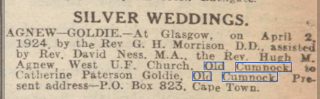
Cumnock Chronicle 1924


Goldie’s shop with canopy. It was extended round the corner into Hamilton Place.


The first of John & Margaret Goldie's surviving children was Catherine Paterson Goldie who was born in 1885 in Cumnock and died in 1964 at Port Elizabeth, Natal, South Africa. Catherine married the Rev. Hugh Agnew, Minister of The United Free Church, West, Cumnock, in Glasgow in 1924. Hugh had been ordained in 1922 and met Catherine through her family's close connections with the church. She was eight years older than Hugh. 

Silver Wedding Announcement 1949 - from Cumnock Connections Tree

Rev. Hugh Agnew served The United Free Church, West, from 1922 - 1930 and wrote 'The United Free Church West, Cumnock's History 1773 - 1923, published in 1923 by The Cumnock Chronicle Press. The box shaped church is the oldest church building left in Cumnock. After being a council storage facility it stood derelict for some years before being turned into The Box Cafe.


United Free Church West


Rev. Hugh Agnew sitting beside his father-in-law John Goldie


In 1929 Catherine and Hugh moved to Dundee where Hugh served as Minister at St. David's North Church until 1933 when they decided to emigrate to South Africa. His first charge in South Africa was St. George's Church, East London. 

The lives of the natives were most un-Christian. Not surprising conditions considering the hovels they were living in"
Rev. Hugh Agnew

Hugh took action. He managed to persuade the South African Minister of Finance to visit the place and the outcome was that he secured a £12 million project for the abolition of some of South Africa's most squalid slums. Medical schemes were set up and new locations, complete with water systems and other modern fittings, were built. His final charge was as Minister of St. Andrew's Presbyterian Church in Cape Town. This church had been formed by a detachment of Cameron Highlanders stationed at Cape Town in 1828 after financial grants had been received from the Dutch Reform Church and German Lutheran Church.

Catherine and Hugh did manage to visit Cumnock again a few times accompanied by their sons Hugh, who had been born in Cumnock and became a gynaecologist in South Africa and Ian, who had been born in Forfar, Scotland. Like Catherine, Rev. Hugh also died in South Africa.

Obituary 1/11/1957 - Dundee Obituary Books findmypast 1869 - 2018
Rev. Hugh M. Agnew, popular minister of St. David's North Church, Dundee from 1929-1933, when he went to South Africa, has died in East London, South Africa. He was 64. In South Africa he had been a minister in East London & Port Elizabeth and was General Secretary of  the Presbyterian Church of South Africa before re-entering the pastoral charge of St. Andrew's, Cape Town. He became Moderator of the Presbyterian Church of South Africa. While he held the position, four years ago he represented the South African Church at the General Assembly of the Church of Scotland. He revisited Dundee at that time. A friend of the late General Smuts, he instigated a £12 million project for the abolition of some of South Africa's most squalid slums.

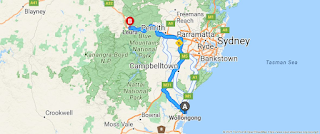
John and Margaret's second child was Robert Dunlop Goldie who was born in 1887 in Cumnock. He attended the Universities of Edinburgh and Cambridge and graduated M.B., Ch.B. and D.P.H., after which he began work as House Physician and House Surgeon at Glasgow Royal Infirmary. He emigrated to Australia in 1912 and commenced practice in Scarborough, Australia. At the beginning of WW1 in 1914 he enlisted with the Royal Army Medical Corps RAF and left with one of the first contingents of military reservists. He was promoted to Major and was awarded the French Honour, Medaille d’Honneur des Epidemies. On his return to Australia after WW1 he commenced practice at Corrimal, which is a suburb of Wollongong, New South Wales and in 1929 he commenced practice at Wollongong. During his very successful career in Australia Robert served as Commonwealth & State Medical Officers. Robert married Margaret (Daisy) Sellers in 1920 in Sydney and they went on to have four children. He died suddenly in 1952 while on holiday at Leura in the Blue Mountains in New South Wales. He named his house in Wollongong Glaisnock.


Leura and Wollongong, New South Wales


The third child of John & Margaret Goldie was Andrew who was born in 1889 in Cumnock and died in 1947 at 2 McCall Avenue, Cumnock. Andrew was the only one of their children to remain in Cumnock. He followed his father into the drapery trade and worked alongside him in the shop. Andrew married Janet Murdoch Gardiner in 1915 at Blythswood, Glasgow. Janet was born in 1881 in Auchinleck and died in 1965 at 2 McCall Avenue, Cumnock. 

Andrew and Janet had one son, John Dunlop Goldie who was born in 1920 in Cumnock. John, who was known as Jack, was a spitfire pilot in WW2. He was a sergeant with 542 Squadron, Royal Air Force Volunteers and was killed in action 26/1/1943 while on a photo recce sortie to Ghent, Belgium. Jack is buried at Eeklo Communal Cemetery, Belgium. He had only been married a short time when he was killed.

Fourth child John Kennedy Goldie (Kenny) was born in 1893 in Lugar Street, Cumnock. Kenny didn't keep good health and in 1913 he decided to emigrate to New Zealand in the hope that the milder climate would improve his condition. He managed to find employment as a warehouseman in Newmarket, a suburb of Auckland, New Zealand. WW1 was declared and in 1915 Kenny enlisted with the New Zealand Expeditionary Force, 2nd Battalion, Otago 9th Infantry Regiment. He was sent on active service to Egypt then France. His health worsened and in December 1916 he was admitted to hospital where he was diagnosed with tuberculosis. He was permanently discharged on 22nd December 1917.  The reason given was that he was no longer physically fit for war service because of a pre-enlistment disability aggravated by active service. On discharge he was recommended for a pension as his capacity for earning was only one half.

Records show that Kenny suffered from this condition pre-enlistment so it's surprising that he was accepted as a soldier. Tuberculosis caused breathing difficulties among other things. Chlorine gas was used for the first time by the Germans in 1915. When inhaled it caused soldiers to have difficulty breathing and sometimes death. Before gas masks were distributed soldiers would soak cloth in urine and hold it to their faces to prevent them from breathing in the gas. 

In 1919 Kenny married Lucy Mabel Booth but sadly he had a short life and died in 1925 in Auckland, New Zealand.

The youngest child of John and Margaret was Hugh Dunlop Goldie who was born in 1897 in The Square, Cumnock. Hugh served his apprenticeship as an engineer & fitter with George McCartney & Co. in Cumnock before enlisting with the Queen's Own Cameron Highlanders in 1914. He saw active service in Salonika where he contracted malarial and rheumatic fever. He was invalided out and returned to Cumnock where he was employed as a motor engineer by Messrs. H.D. Hunter. In 1922 he emigrated to Auckland, New Zealand to join his brother Kenny who had tuberculosis. Kenny died in 1925 and in 1935 Hugh left New Zealand for East London, South Africa, where his sister Catherine and her family lived. Unfortunately Hugh had a recurrence of the old rheumatic fever and died in 1939 at Frere Hospital, East London, South Africa.