About the project

Our project

Showing posts with label New Zealand. Show all posts

Tuesday, 4 March 2025

Extended family of McGlashan, McCowan & Dalglish to Australia and New Zealand

by Kay McMeekin

Archibald McCowan and wife Sarah Hair and their children emigrated on the Hurricane, Glasgow to Port Phillip (Melbourne) in June 1853  as a farmer.

Gilbert McGlashan, son of Dr Gilbert McGlashan in Cumnock was born in East Kilbride on 24 Oct 1835  and died on 7 Feb 1918 in St Arnaud, Victoria, Australia. Gilbert named his house Glaisnock in St Arnaud, New Zealand 

He was an engineer, operated a foundry and engineering works and designed agricultural equipment. 

He emigrated about 1859 and married Agnes McCowan daughter of the aforementioned Archibald McCowan in 1862 in Melbourne,

Meanwhile Gilbert's sister Eliza Woodhead McGlashan born 1833 married in 1861 and emigrated to New Zealand with her new husband James Dalglish and his brother.

James Dalglish was born in Barn Street, Strathaven, on 28 Feb 1834 to William Dalgliesh and Catherine Currie. In 1841 he was living in Lanarkshire, but by April 1861 he had moved to Old Cumnock. James lived in Glaisnock Cottage, Old Cumnock, working as a woodcutter with his brother, Hugh.  

painted by Marie Benseman  Dalglish, married to James’s grandson, Ken Dalglish
    
James Dalglish


On 27 June 1861, James married Eliza Woodhead McGlashan, the daughter of a surgeon, who had moved to Old Cumnock after his first wife, Eliza's mother, had died. 

After the wedding, James and Eliza sailed to  New Zealand on the Asterope with Hugh Dalglish, arriving in Wellington on 11 Oct 1861.James and his brother worked as woodcutters in New Zealand, and James purchased a large block of land in Le Bons Bay, Banks Peninsula.Together they set up a sawmill on the land and felled the trees to make a sheep farm, where they lived. James became a significant landowner and businessman, and was a prominent figure in politics in the Canterbury Province.

Letters to Elizabeth Woodhead McGlashan from her brothers Alexander and William from 1846 -1870 have been transcribed.

William McGlashan enlisted about 1850 for 14 years as a gunner in 1st Company 2nd Battalion Artillery and was sent to East India on the ship Camperdown. He served in Lahore, Scutari and Dalhousie, Punjab. He suffered numerous bouts of ill health, and is presumed to have died there.

Brother Alexander McGlashan left Cumnock to become an accountant in Glasgow. In 1846 he was working in a Customs House in Liverpool (from correspondence with sister Eliza). In August 1847 a 21 year old Alexander McGlashen was jailed in Liverpool for embezzlement for 3 months. There was no letter to Eliza until November 1847. So it is likely the same man. He likely lost his job and that would be the reason for joining the army,

He joined the 4th Royal Irish Dragoons, and went to fight in Crimea, where he had cholera tended by Florence Nightingale and her nurses in Scutari Hospital. He was also in Bengal and Lahore in 1853. He survived to serve around Britain in Newbridge, Newcastle, Exeter and Aldershot.

He married widow Annie Rowlinson in 1868 (his father's name and occupation on the marriage certificate confirms this) and he died in 1891 in Salford.

Information, in particular the letters, from descendant of Eliza, Kathryn Dalglish Chandler. Letters transcribed 1998 by Margaret Frampton.


Tuesday, 6 February 2024

Ministers (and their families) immigrating to the Dunedin area of New Zealand in the mid 1800's

 By Scott Daily

Through the years many have moved from East Ayrshire to New Zealand, quite a large number of these settled in the Otago region, especially in what became the city of Dunedin. To quote directly from Tearra, the “Encyclopedia of New Zealand” website , “With clear rivers and brisk frosts reminiscent of home, Otago was where a group of Free Church Scots founded their ‘new Edinburgh’, Dunedin, in 1848. They had high moral values, and a belief in hard work and the value of education. Today, clans and tartans, Burns night celebrations, and tossing the caber, are part of a lasting legacy." 

Established in 1845, the Otago Association was founded by the Free Church of Scotland to set up a colony in New Zealand. By the 1850s over 12,000 people immigrated from the United Kingdom to the area around Dunedin. Among these immigrants were several ministers who were born in Ayrshire.

Perhaps the best known of these was Thomas Burns, nephew of Robert Burns. Thomas was born in 1796 in Mauchline. After graduating from University of Edinburgh, with a degree in theology, he was ordained as a minister to the parish of Ballantrae, later transferring to Monkton, both in South Ayrshire. In 1843, during the Disruption of Church of Scotland, Burns left the established church and joined the Free Church of Scotland. 
In 1847 he, and his family (his wife, 5 daughters and one son) set sail for New Zealand on board the Philip Laing one of the first ships chartered by the Otago Association. For a time Burns functioned as the only minister for the area; later when other Free Church ministers arrived a Presbytery of Otago was formed, with Burns elected the first Moderator. Burns passed away in 1871, and is buried in Dunedin, where there is also a monument to him for his service to the community.

grave of Thomas Burns in Dunedin


Besides members of the Free Church, many other religious Scots immigrated to the area. Thomas Burns recorded 1,000 Presbyterians, 250 Anglicans, 61 independent church members, and 11 Catholics, living in Dunedin in 1856. 

Of special relevance to this page about Cumnock immigration is David Johnstone who was born in Old Cumnock in 1822, and went on to become a pastor in Dunedin.  Johnstone (sometimes spelt Johnston) had first served in the 1850s as pastor of an Indepedent church or chapel on Great Hamilton Street, Glasgow. In 1866 his wife, Jessie, passed away. By 1869 Johnstone had moved with his children to New Zealand, as he is recorded as serving as the pastor of the Congregational church located at the corner of Vine Street and Moray Place in Dunedin. Johnstone only served at the Moray Place church for a year before he began to hold services in the Oddfellows’ Hall George Street, before having a new Congregational church built on Leith Street and becoming its first pastor. see-congregationhistory 
Johnstone is recorded in various New Zealand census and electoral rolls as serving as clergyman in Dunedin for many years, evetually dying in 1896 still in Dunedin. A number of his at least 6 children married New Zealanders and stayed in the area with families of their own.


One final example of a minister orginally from East Ayrshire is the Rev. James Kirkland, who was born in Stewarton in 1832.  Though the region of Otago was intially extremely Presbyterian, the discovery of gold in the area in the 1860s resulted in a gold rush with so many moving to the area from places such as Australia that soon there was a shortage of Presbyterian ministers, and so a call went out for more ministers. James Kirkland was one of those who answered the call. He and his family (wife Mary, and 3 children) moved first to Inch Clutha in 1863, where James served as the minister until 1872. After serving for a few years in Hokitika, James would be called to serve at West Taieri near Dunedin. He would remain the minister there for over 20 years. At least 3 more children were born to family in New Zealand, the notice of his death (pictured below) states that he had 9 children, one of the sons would also become a minister in the area. James was honoured for his long service to the Synod of Otago and Southland. His gravestone, in Dunedin, states he served as a minister in New Zealand for 39 years. 
Rev James Kirkland's grave, Dunedin


Notice of Rev Kirkland's death


Saturday, 30 December 2023

The migrant miners – Barrowmans from Stirling to New Zealand via Lanarkshire and Ayrshire.

by Alexandra Watson

Barrowman is a “weel kent” name in Cumnock and has various historical associations.

Robert J Barrowman (1847- 1924) is best remembered as the builder of the Royal Hotel in 1892 which still has a commanding role in the town.

Alexander Barrowman (1842 - 1913) journalist and poet was very well known in Cumnock in his day. (The late Bobby Grierson was interested in Alexander and documented his tree on Cumnock Connections). There are not many obituaries that say:

"It is not too much to say that Mr Alexander Barrowman was one of the the most prominent figures in the contemporary history of Cumnock and we make bold to say further that the town held no finer brain than that which he possessed." 

Source: Cumnock Chronicle 1913

With such an unusual surname, one might be forgiven for assuming that all the Cumnock Barrowmans were from the same family. However, Robert J Barrowman’s lineage goes back to an Irish migrant Daniel Barrowman who married a Jane Pollock in Lanarkshire at the beginning of the 19th century and in comparison, Alexander’s family were originally from Airth in Stirlingshire. What both families had in common was that the mining industry played a major part in their family's migrations and success stories.

Of course, other Barrowman families may also have come to the area but this essay deals with the story of the Airth Barrowmans.

The Barrowmans of Dunmore and Airth


This account follows the emigration story of the father and brothers of
Alexander Barrowman who died in Cumnock in 1913.
Located on the River Forth 6 miles north of Falkirk, is the small village of Airth. As early as the 16 century it was a trading port, known for shipbuilding, agriculture, fishing, salt production, and coal mining. 
This branch of the Barrowman family appears in the earliest Airth church records from the 1600s. The family grew to be quite numerous in the area but by the 1841 census, the name appears to have died out. 
By 1841 there are several Barrowman families (born in Airth) now living in and around Lanarkshire and many are miners. William Barrowman and Susannah Cairns were married on 15 August 1774 at Airth and continued to live there for several years. However, their son John Barrowman moved to Shettleston, Glasgow, and died there in 1829.

John Barrowman married Margaret Matson on 5th August 1803. They had 11 children, all lived to adulthood, and at least 3 of whom emigrated to America.
We are following their 6th child Thomas Barrowman, born 1813 in Shettleston in Glasgow.

Thomas Barrowman 1813 - 1881

Tuesday, 26 December 2023

The family of John Goldie, draper

 by Roberta McGee

John Goldie was born in 1858 in Catrine, the eldest son of Andrew Goldie, a weaving master with Messrs James Findlay & Co., Catrine and Agnes Kennedy, a power loom weaver. He served his time in the drapery trade in Glasgow where he formed a life-long friendship with The Hon. George Fowlds who became Minister of Education in New Zealand. In 1881 John took over the drapery business in Lugar Street, Cumnock from John Baird, the donor and founder of the Baird Institute. That same year, on 27th December, he married Margaret Dunlop in Catrine. 

John and Margaret soon became very much part of the community in Cumnock, being closely involved in the United Free Church, West and both becoming Justices of the Peace. Sixteen years later John acquired the house at the Hamilton Place corner of The Square and he transformed the building, adapting it to his rapidly extending business as a draper, ladies' & gent's outfitter etc. and there he remained, actively engaged, almost to his death. John died in 1939 at 9 Herdston Place, Cumnock. He was 80 years old. His wife Margaret died in 1951 in Cape Town, Cape Province, South Africa, the home of her daughter Catherine. She was 92 years old. 


Cumnock Chronicle 1924


Goldie’s shop with canopy. It was extended round the corner into Hamilton Place.


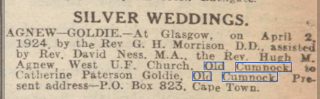
The first of John & Margaret Goldie's surviving children was Catherine Paterson Goldie who was born in 1885 in Cumnock and died in 1964 at Port Elizabeth, Natal, South Africa. Catherine married the Rev. Hugh Agnew, Minister of The United Free Church, West, Cumnock, in Glasgow in 1924. Hugh had been ordained in 1922 and met Catherine through her family's close connections with the church. She was eight years older than Hugh. 

Silver Wedding Announcement 1949 - from Cumnock Connections Tree

Rev. Hugh Agnew served The United Free Church, West, from 1922 - 1930 and wrote 'The United Free Church West, Cumnock's History 1773 - 1923, published in 1923 by The Cumnock Chronicle Press. The box shaped church is the oldest church building left in Cumnock. After being a council storage facility it stood derelict for some years before being turned into The Box Cafe.


United Free Church West


Rev. Hugh Agnew sitting beside his father-in-law John Goldie


In 1929 Catherine and Hugh moved to Dundee where Hugh served as Minister at St. David's North Church until 1933 when they decided to emigrate to South Africa. His first charge in South Africa was St. George's Church, East London. 

The lives of the natives were most un-Christian. Not surprising conditions considering the hovels they were living in"
Rev. Hugh Agnew

Hugh took action. He managed to persuade the South African Minister of Finance to visit the place and the outcome was that he secured a £12 million project for the abolition of some of South Africa's most squalid slums. Medical schemes were set up and new locations, complete with water systems and other modern fittings, were built. His final charge was as Minister of St. Andrew's Presbyterian Church in Cape Town. This church had been formed by a detachment of Cameron Highlanders stationed at Cape Town in 1828 after financial grants had been received from the Dutch Reform Church and German Lutheran Church.

Catherine and Hugh did manage to visit Cumnock again a few times accompanied by their sons Hugh, who had been born in Cumnock and became a gynaecologist in South Africa and Ian, who had been born in Forfar, Scotland. Like Catherine, Rev. Hugh also died in South Africa.

Obituary 1/11/1957 - Dundee Obituary Books findmypast 1869 - 2018
Rev. Hugh M. Agnew, popular minister of St. David's North Church, Dundee from 1929-1933, when he went to South Africa, has died in East London, South Africa. He was 64. In South Africa he had been a minister in East London & Port Elizabeth and was General Secretary of  the Presbyterian Church of South Africa before re-entering the pastoral charge of St. Andrew's, Cape Town. He became Moderator of the Presbyterian Church of South Africa. While he held the position, four years ago he represented the South African Church at the General Assembly of the Church of Scotland. He revisited Dundee at that time. A friend of the late General Smuts, he instigated a £12 million project for the abolition of some of South Africa's most squalid slums.

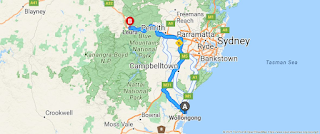
John and Margaret's second child was Robert Dunlop Goldie who was born in 1887 in Cumnock. He attended the Universities of Edinburgh and Cambridge and graduated M.B., Ch.B. and D.P.H., after which he began work as House Physician and House Surgeon at Glasgow Royal Infirmary. He emigrated to Australia in 1912 and commenced practice in Scarborough, Australia. At the beginning of WW1 in 1914 he enlisted with the Royal Army Medical Corps RAF and left with one of the first contingents of military reservists. He was promoted to Major and was awarded the French Honour, Medaille d’Honneur des Epidemies. On his return to Australia after WW1 he commenced practice at Corrimal, which is a suburb of Wollongong, New South Wales and in 1929 he commenced practice at Wollongong. During his very successful career in Australia Robert served as Commonwealth & State Medical Officers. Robert married Margaret (Daisy) Sellers in 1920 in Sydney and they went on to have four children. He died suddenly in 1952 while on holiday at Leura in the Blue Mountains in New South Wales. He named his house in Wollongong Glaisnock.


Leura and Wollongong, New South Wales


The third child of John & Margaret Goldie was Andrew who was born in 1889 in Cumnock and died in 1947 at 2 McCall Avenue, Cumnock. Andrew was the only one of their children to remain in Cumnock. He followed his father into the drapery trade and worked alongside him in the shop. Andrew married Janet Murdoch Gardiner in 1915 at Blythswood, Glasgow. Janet was born in 1881 in Auchinleck and died in 1965 at 2 McCall Avenue, Cumnock. 

Andrew and Janet had one son, John Dunlop Goldie who was born in 1920 in Cumnock. John, who was known as Jack, was a spitfire pilot in WW2. He was a sergeant with 542 Squadron, Royal Air Force Volunteers and was killed in action 26/1/1943 while on a photo recce sortie to Ghent, Belgium. Jack is buried at Eeklo Communal Cemetery, Belgium. He had only been married a short time when he was killed.

Fourth child John Kennedy Goldie (Kenny) was born in 1893 in Lugar Street, Cumnock. Kenny didn't keep good health and in 1913 he decided to emigrate to New Zealand in the hope that the milder climate would improve his condition. He managed to find employment as a warehouseman in Newmarket, a suburb of Auckland, New Zealand. WW1 was declared and in 1915 Kenny enlisted with the New Zealand Expeditionary Force, 2nd Battalion, Otago 9th Infantry Regiment. He was sent on active service to Egypt then France. His health worsened and in December 1916 he was admitted to hospital where he was diagnosed with tuberculosis. He was permanently discharged on 22nd December 1917.  The reason given was that he was no longer physically fit for war service because of a pre-enlistment disability aggravated by active service. On discharge he was recommended for a pension as his capacity for earning was only one half.

Records show that Kenny suffered from this condition pre-enlistment so it's surprising that he was accepted as a soldier. Tuberculosis caused breathing difficulties among other things. Chlorine gas was used for the first time by the Germans in 1915. When inhaled it caused soldiers to have difficulty breathing and sometimes death. Before gas masks were distributed soldiers would soak cloth in urine and hold it to their faces to prevent them from breathing in the gas. 

In 1919 Kenny married Lucy Mabel Booth but sadly he had a short life and died in 1925 in Auckland, New Zealand.

The youngest child of John and Margaret was Hugh Dunlop Goldie who was born in 1897 in The Square, Cumnock. Hugh served his apprenticeship as an engineer & fitter with George McCartney & Co. in Cumnock before enlisting with the Queen's Own Cameron Highlanders in 1914. He saw active service in Salonika where he contracted malarial and rheumatic fever. He was invalided out and returned to Cumnock where he was employed as a motor engineer by Messrs. H.D. Hunter. In 1922 he emigrated to Auckland, New Zealand to join his brother Kenny who had tuberculosis. Kenny died in 1925 and in 1935 Hugh left New Zealand for East London, South Africa, where his sister Catherine and her family lived. Unfortunately Hugh had a recurrence of the old rheumatic fever and died in 1939 at Frere Hospital, East London, South Africa.


Friday, 22 December 2023

Robert Smith, Ochiltree to Eastern Cape Province

By Elaine Corbett
Robert Smith  was a farmer’s son from Whitehill Farm, Ochiltree.
Follow this link to the farm post for Whitehill on our blog Ploughing Up Our Past.

Robert was my 2nd great grand-uncle, brother of my great, great grandfather, David Smith.

He was the third son of Robert Smith and Jane Guthrie born in 1835, and must have been recognised as being a bright lad and encouraged to pursue his studies. The remaining sons all stayed farming. 

The 1851 census finds him in Ochiltree village with, (we think) his great-aunt, Elizabeth Wallace so it is evident he was sent away from the distraction of his siblings to get on with his book learning.
In 1861 he was living in Aberdeenshire as a teacher, and in 1862 he married Margaret Anderson, in Binns Farm, Urquhart. Margaret’s family were interesting, as her father was a farmer and ship owner. Her uncle was a sea captain before he too bought into a shipping company and settled in Glasgow with his Danish wife.
The 1871 census sadly, shows that Robert had gained two sons, William and Robert, but Margaret had died from complications of childbirth. His occupation was now Bank Agent. 
In 1872 he married Mary Mather and they set up home together in Union Street, Aberdeen. They had four children before Mary died in 1888 from Tuberculosis. 
Despite his personal tragedies, Robert’s career seems to have been doing well, and by the 1891 census, he had decided to emigrate to King William’s Town, East Cape Province, South Africa and had become the manager of the Bank of South Africa there. The children were staying with family getting ready to join their father and begin their new life.
The younger boys David Guthrie Smith, and John Ogilvie Smith, and daughter Jessie MacLean Smith were staying with Mary’s sister in Glasgow, while Mather, the oldest of Mary’s children was with Uncle Hugh at Whitehill Farm. The sons from his first marriage seem to have left home and were building their own lives. Their names were Robert Smith, and William Anderson Smith.
Robert stayed in Scotland and qualified as a doctor, and found a medical practice in Assam, India, but unfortunately died there aged just 30.
William Anderson Smith was studying Arts in Aberdeen University, but no trace after that in UK records, until the very last clipping posted here.
There was also an adopted daughter called Elizabeth Anderson, but I can’t find any trace of her, or even who her mother and father might have been.
Of the remaining family, it seems they had an exciting life in South Africa.

The Smith family had not long been in South Africa before the Second Boer War began. Although a relatively short war, from 1899 to 1903  it was quite brutal. Much of it was conducted under guerilla tactics, sieges, and was the first war we saw mention of concentration camps. It was fought using cavalry swords, rifles and bayonets, and cannon. All three of Robert’s sons who were with him immediately signed up to fight.
Mather joined the 1st Battalion, Imperial Light Horse and his record shows he earned four clasps to his medal for seeing action at the relief of  Mafeking, the Transvaal clasp, the Relief of Ladysmith, and Tugela Heights.
He was wounded at Acton Homes 19th January 1900, where 40 Boers were captured, recovered from his wounds then returned to service. He was finally discharged from service 12th October 1900.
When he was staying with his Uncle, before going out to Eastern Cape, he had been studying engineering. When he married Nellie Sweeten, a Cumbrian girl from Penrith in 1911, he was described as being from the Worcester Gold Mining Company, Barberton, so it seems his engineering studies had come to fruition.

Cumberland and North Westmorland Herald 17th June 1911

Arthur Sweeten was publisher of a newspaper in Penrith, and one of his sons was out in South Africa, so perhaps Nellie met Mather in South Africa.

Saturday, 16 December 2023

Love and War

By Alexandra Watson

 The latter days of the 18th Century

Great events even far away can often impact our surroundings and lives. How many of us who pass through Ayr and see the ruins from Eglinton Street, know that this was the Citadel Fort, commissioned in 1652 and one of a group of five impressive fortresses established following Scotland’s defeat and the establishment of a Commonwealth between England and Scotland. English occupation forces were housed there, with the intention, to repress a still hostile Scots populace. A later addition to the town was The Barracks, built on the south side of Ayr Harbour as part of the British response to the threat of the French in 1795 and it was to there came an English soldier.

The turmoil of the second half of the 18th century saw events that not only changed the world but the individual lives of ordinary people living in Ayrshire. The last Jacobite rising of 1745; the War of American Independence of 1775 -1783; the French Revolutionary Wars of 1792 -1802 and the Napoleonic Wars of 1799 - 1815 and the Irish Rebellion of 1798. Against this background the British government had a real anxiety that there may be alliances amongst disillusioned Scots and Irish and the French. 

In 1794, some one hundred and seventy-five miles away in County Durham, a weaver, John Watson was recruited into the Durham Fencible Cavalry, which changed its name the next year to the Princess of Wales's Fencible Cavalry. It was led by William Vane, who was also Colonel of the Militia.  After spending three years in Scotland, they proceeded to Ireland and were disbanded in 1802. 

“During the French Revolutionary Wars from end 1792 until May 1802 the regiment was tasked with maintaining order as well as anti-invasion duties and for this purpose they were employed outside of their area of recruitment and kept on the move “so as to avoid fraternisation with the local population” 

Source:  https://en.wikipedia.org/wiki/Militia_and_Volunteers_of_County_Durham

Well, as Robert Burns said just about that time in 1785:

“The best laid schemes o' Mice an' Men gang aft agley” 

How and where John Watson met the local girl, Catherine Henrie we will never know. She was born on 11 March 1779, in Kirkmichael, Ayrshire, Scotland. They married in St Quivox on 23 August 1797 and it is known that the army moved supplies such as cattle and horses inland to there, away from the Ayr coast, in case of French raids.

The beginning of the 19th Century

When John left the army they settled in her home village of Kirkmichael and John worked as a weaver. They had at least 5 children who in turn had families. Each of the boys had at least 6 children and so this particular branch of the Watsons was established in Ayrshire.

Our interest is with John's son William and then the line from William's daughter Janet. William was born on 21 June 1802. In the church records he and three siblings are belatedly recorded as Irregular Baptisms, maybe harking back to John’s English background and not originally being a member of the Church of Scotland. William married Euphemia Duncan in Sorn, her home village on 6 June 1826. Euphemia was 27 and William was 23. William moved to Sorn and raised his children there but by 1851 he is back in Kirkmichael. William sadly died relatively young at 54 years old in 1856. However, Euphemia moved to Cumnock with her youngest son James, and lived to the age of 77. Sadly Janet Watson, William and Euphemia’s daughter died at the age of 25 in 1857 having given birth to a son out of marriage. He was called George Henrie Watson and it seemed that his paternity would remain a mystery. However, with the advent of DNA testing, we have noticed multiple links to a Howe Family, also resident in Kirkmichael. We also noted the death of a young man John Howe, ages with Janet who also sadly died the same year as the birth of George. 

The mid 19th Century

So we follow George’s line, he remained in his brother James’s household in Cumnock till he married his next-door neighbour Jeanie Crichton in 1873. Both Jeanie's parents' families had originated in Lanarkshire making their way to Ayrshire for work in the coal industry after their marriage in 1843. Coincidently George and Jeanie’s next-door neighbour in the Barrhill in Cumnock was none other than a certain journalist James Keir Hardie, a founding member of the Labour Party.

The early 20th Century


George Henrie Watson and Jeanie had 7 children. These were very hard times ...The Depression; World War 1 1914 -1918; the National Strike 1926. The girls all followed their husbands for work and left Cumnock. The Yuills and Ronalds headed for Glasgow. George was the first to emigrate and he went to New Zealand. Mary and her husband Alexander Vallance of Burnside farm, Cumnock, headed for Canada and then James too decided to emigrate.  James a recently remarried widower took his new wife and family off to Canada. Only Robert (born 1885) remained in Cumnock but sadly he too died at the young age of 37, leaving behind a young widow and three of a family. Only one son to carry on the Watson name in Cumnock - Hugh Watson.

George Watson (born 1892) had a successful life in New Zealand. He was widowed after 40 years of marriage and then decided to visit Cumnock again. He stayed with his nephew Hugh (mentioned above) and coming home by sea he succumbed “to a shipboard romance” marrying again on his return to New Zealand. The Cumnock Chronicle ran quite a story on George and his visit. 


Happily, James (born 1890) who was also widowed young had married his employer’s (The Craigs from the Guelt Farm, Glenmuir) daughter and set off with his family and new bride to Canada and received a land grant. James fathered five children and his two boys' children established quite "a Watson Clan", in Fredericton, New Brunswick. These Watsons are regular visitors to Scotland as are their children and the connection is as strong as ever. We also hear from the Vallances in Ontario who recently made "an eighteen-strong party expedition" to Scotland.


World Wars

Young Hugh, the son of Robert, was born in 1917 and only 5 when his father died. He was brought up by his mother Elizabeth Crawford Blackwood (1885 - 1963), a well-known and respected figure. Hugh had a very happy life with his mother two older sisters Martha and Jean and his young cousin Jean that is until war intervened. 

Hugh was a grocer and at the outbreak of the war, he went with two friends to enlist. The three of them were attracted to the glamour of the Air Force, the queue was long and being processed alphabetically so the W’s were last to be signed. His two friends successfully were enrolled into the Air Force before him but Hugh had to take the army. Sadly as the attrition rate was high in the Air Force it might come as no surprise that Hugh’s friends never made it home.


Hugh was in the Black Watch and was taken prisoner on 11 June 1940.


source:  https://51hd.co.uk/history/valery_1940

This is not the place to record the horrors of the situation, the enforced marches, the near starvation, the deaths and the misery of war. Hugh was the most optimistic and positive man you could meet. At home, his widowed mother and sisters feared for his life.  


Calum MacIver bottom right and Hugh Watson top left in Stalag XX1D (Poland)


Hugh did make it home but fate brought that twist of love and war exactly like in the John Watson & Catherine Henrie marriage, meeting his wife only because of the war. 

The first John Watson’s home in Durham had been one hundred and seventy-five miles away from Cumnock. At an even longer distance of three hundred and twenty-eight miles in a tiny village on the Hebridean island of Lewis, a baby was born to Murdo MacIver and Isabel MacLean. She was Eiric Mhuruchaidh Iain Aonghais and spoke no English till the age of six. Effie, as she was known, was a really clever girl and wanted to be a nurse. In those days you had to pay for your training, so she went to the capital city of Edinburgh and worked as a servant till she raised sufficient money. She had two brothers and a sister named Barbara. The latter came to Edinburgh with her and their brothers enlisted; John into the navy and Calum into the army. In 1940 the family was advised that Calum too had been taken prisoner by the Germans. Effie worked hard and eventually became a Ward Sister in the prestigious Edinburgh Royal Infirmary. In those days women who held those positions did not marry and had rooms on site. The war was hard for her too as not only did they treat civilian patients from the city but British soldiers and German soldiers too – an irony when her brother was imprisoned there.

Effie far right

Calum and Hugh were in the same prisoner-of-war camp and became very close friends. The end of the war came and Calum came home and married his sweetheart Cathy and in those days a Lewis wedding lasted for days. Effie, Barbara, and one of Barbara's friends, Mary Dougan, went up north for the wedding. Not long after the wedding Effie decided to visit Barbara's friend who was now married and living back in her native Ayrshire. The friend knew Hugh Watson and the connection between Calum and Hugh and arranged for Effie to meet Hugh...and the rest is history. 

There are no Watsons from Jeanie Crichton and George Henrie Watson's line living in Cumnock but all have a piece of Cumnock in their hearts.


Tuesday, 21 November 2023

John Lowther

 by Roberta McGee

John Lowther was born in 1889 in Cockermouth, Cumberland, England. His father was Wilfred Lowther, a hawker, born in Bootle, Cumberland in 1866 to James and Eleanor Lowther (nee Burns), who were earthenware dealers. James came from a long line of Cumberland potters.

In 1881 Wilfred can be found in Kendal living with his sister Mary and her husband Joseph Miller. The Millers were a large travelling family of hawkers and horse dealers.


Wilfred married Elizabeth Moorehead in January 1888 at Cockermouth and their son John Lowther was born there in 1889. However, their marriage was short-lived because Wilfred died suddenly in April 1889, aged 22 years, at their house in St. Helen's Street, Cockermouth. So, at 21 years , Elizabeth was a widow. She moved, with her son, to Watchhill, Allhallows, Cumberland, to live with her widowed mother Betty Moorehead who had a grocer's shop there. 

By 1895 William Moorehead, Betty's son (Elizabeth's brother), was living in Old Cumnock and Betty, Elizabeth and John joined him there. William had been a coal miner in Allhallows but was now managing a lodging house in Elbow Lane, Cumnock. They did have connections in the area. Betty's brother was John Hall, a hawker, later swine dealer, who had married Jane Cunningham, the sister of Bob (Dishy) Watsons mother Christina Cunningham. The Halls had emigrated to Australia in 1887. 

On 31st December 1897 at Elbow Lane, Cumnock, Elizabeth married Hugh Walker.
Marriage Certificate:
Hugh Walker aged 30 years, hawker, bachelor, Lugar Street, Cumnock. Father: John Walker, coal miner Mother: Annie Walker ms McMillan deceased to Elizabeth Moorehead, aged 29 years, widow, Elbow Lane, Cumnock Father: John Moorehead, mason, deceased Mo: Elizabeth Moorhead ms Hall. Witnesses: William Moorehead and Hannah Hodgson.

In 1901 Betty Moorehead, John Lowther's grandmother, is managing the lodging house in Elbow Lane, Cumnock, assisting her 35 years old son William who is described as 'lodging house keeper'. There were 35 boarders. Her daughter, now Mrs Hugh Walker, is living in Townhead Street with her husband who is a china hawker, her son John Lowther aged 12 years, daughter Agnes Walker aged 3 years and son John Walker aged 8 months. So she had two sons named John, albeit with different surnames, carrying on the family tradition on both sides of the family it seems. 

Sadly Betty Died on 30th October 1903 at Elbow Lane, Cumnock.
Death Certificate:
Betty Moorehead, aged 67 years, widow of John MacKenzie Moorehead, hawker. Father: George Hall, horse dealer deceased Mother: Catherine Hall ms Lowther deceased. Cause of Death: Chronic Bright's Disease. Informant: Wm. Moorehead, son.

On 31st December 1914 John Lowther married Christine Watson, the sister of Bob (Dishy) Watson.
Marriage Certificate:
At 4 Minerva Street, Glasgow by Declaration in presence of Robert Watson, general dealer and Agnes Walker, spinster, John Lowther, aged 25 years, fish salesman, bachelor, 104 Townhead Street, Old Cumnock  Father: Wilfred Lowther, general hawker deceased Mother: Elizabeth Lowther now Walker ms Moorehead to Christina Watson, aged 24 years, Wood Street, Catrine Father: Robert Watson, horse dealer Mo: Christina Watson ms Cunningham.

John and Christina had three children together, Wilfred born 1916 Cumnock, Christina born 1917 Cumnock and Betty born 1919 Cumnock.

1918 proved to be a tragic year for John and his family.  There was an influenza epidemic in Cumnock and his young half-sister Annie Walker died on 8th July 1918 at Townhead Street. She was thirteen years old. Her death was followed by that of her sister Elizabeth Walker on 18th October 1918. She was sixteen years old. 

Two and a half years later John's wife Christina Cunningham Watson Lowther died on twenty sixth of January 1921 at 89 Townhead Street, Cumnock. She had suffered from Jacksonian epilepsy for eight years and died from heart failure. John was left with three small children to raise. Christina's sister Mary Ann Watson stepped in and took care of them while John worked as a fish salesman and at the end of the year John and Mary got married.
Marriage Certificate:
On 27th December 1921 at The County Buildings, Ayr by Declaration in presence of William Hodgson, fishmonger and Elizabeth Watson or Hodgson, both of 89 Townhead Street, Old Cumnock John Lowther, aged 37 years, fish salesman, widower, 89 Townhead Street, Old Cumnock  Father: Wilfred Lowther, horse dealer deceased Mother: Elizabeth Lowther ms Moorehead to Mary Watson aged 25 years, housekeeper, spinster, 89 Townhead Street, Old Cumnock Father: Robert Watson, china merchant Mother: Christina Watson ms Cunningham deceased.

John and Mary's son, Robert (Bobby) Watson Lowther was born in 1924 in Cumnock. 

John and Mary decided to emigrate to New Zealand and on 13th April 1926 they boarded the ship 'Mahona' at Liverpool and set sail for Auckland, New Zealand.

Passenger List - 13/4/1926 - Ship 'Mahona' - Liverpool to Auckland, New Zealand
John Lowther 33 fishmonger, Mrs John Lowther 29 wife, Wilfred Lowther 10, Christina Lowther 9, Betty Lowther 7, Robert Lowther 2 
89 Townhead Street, Old Cumnock, Ayrshire 

On 30th November 1927 their son John (Jack) Cunningham Watson Lowther was born in New Zealand. When Jack was in his twenties he visited Cumnock and fell in love with his cousin Christine Watson whose father was Bob Watson (Dishy). Jack and Christine were married in 1950 at Blythswood, Glasgow. They opened a fish and chip shop in her parents' house in Townhead Street but eventually Jack returned to New Zealand/Australia accompanied by his new wife. 

John Lowther's children with Christina Watson

1.     Wilfred Watson Lowther was born in 1916 in Old Cumnock and died 8/4/1985 at 
        141 Musselburgh Rise, Dunedin, New Zealand. He was 69 years old and a retired sales
        consultant. He married Agnes Sheila Brown on 28/7/1946 at St. Joseph's Cathedral.
        Dunedin.

2.    Christian (Christina) Cunningham Lowther was born in 1917 in Old Cumnock
       and died in New Zealand.

3.    Elizabeth (Betty) Moorehead Lowther was born in 1919 in Old Cumnock and died after
       1954 in New Zealand.  The 1954 Electoral Roll shows her living at 66 Harbour Terrace,
       North Dunedin, Otago, New Zealand. She is a spinster and is living with her widowed
       mother Mary Lowther.


John Lowther's children with Mary Ann Watson

4.    Robert (Bobby) Watson Lowther was born in 1924 in Old Cumnock and died 4/6/1981 at
       Dunedin, Otago, New Zealand. Bob married Margaret Joyce Armstrong.

5.    John (Jack) Cunningham Watson Lowther was born 30/11/1927 in New Zealand and
       died 9/1/1991 in Queensland, Australia. He married Christine Watson in 1950 at Blythwood,                    Glasgow and they lived for a time in Townhead Street, Cumnock.  Christine is the daughter of               Robert Watson and Maggie McGee of Cumnock.


                                                             Brothers Bobby & Jack Lowther


John Lowther died 21st September 1946 in Dunedin, New Zealand. He was 57 years old. Mary, his wife, died 2nd February 1979 also in Dunedin, New Zealand. Mary was 82 years old. They are buried in Anderson's Bay Cemetery, Dunedin. A horse's head is etched on the gravestone, perhaps a nod to his traveller's background.  

John Lowther's journey through life took him from Cumberland to Cumnock and from Cumnock to Australia and New Zealand. He had experienced the joy of his children's births and the heartache of the death of his first wife and of his two young half-sisters in Cumnock. He found happiness again with his second marriage and courageously moved to the other side of the world to make better lives for his family. Being part of the travelling community and having relatives already in Australia and New Zealand would have helped the family settle in more easily. 


Tuesday, 14 November 2023

Robert Watson

 By Roberta McGee, (whose husband is nephew of Margaret McGee!)


                                                  Bob & Maggie -   Cumnock Chronicle 1966

Bob Watson, known in Cumnock as 'Dishy',  was born around 1896, whether in England or Stranraer is uncertain, and was descended from a long line of potters and china salesmen who travelled the length and breadth of the country selling their wares. They lived in caravans and were a well respected part of the travelling community.


Bob's grandfather was John Watson who was born about 1815 in Abbey Holme, Cumberland, England and his grandmother was Ann McKenzie who was born about 1818 in Dearham, Cumberland. The 1851 census shows them living 'at camp' in Orton, Cumberland and gives John's occupation as a 'rag gatherer'. Living next door to them are a family of McKenzies who are 'pot dealers', perhaps grandmother Ann's brother and family. By 1861 the family are living in Glasson, Drumburgh, which was a small settlement in Cumberland just inland from the Solway coast and about eight miles from Carlisle. Both John and Ann's occupations are given as 'dealers in potts or potter'. Bob's father Robert is on this census. He is sixteen years old and is also 'a dealer in potts or potter' which meant that they were selling wares from potteries as opposed to making them. Also on this census are Robert's siblings Elizabeth and Anne. The family's location was close to canals and railways which would make it easier for them to pick up and distribute the wares. They were, in fact, the equivalent of modern day commercial travellers. In 1871 the family are still living in Drumburgh and John's occupation is 'horse dealer', while his wife Ann and daughter Elizabeth's occupations are 'hawkers'.

On 2nd March 1871 Robert Watson married Christine Cunningham at Catherdral Lodge, Castle Street, Glasgow in the High Church district. Christina came from a long line of travellers and was born in England in 1851,

Marriage Certificate:
By Declaration in the presence of John Hall, horse dealer, and Jane Cunningham or Hall, his wife, Robert Watson aged 24 years, horse dealer, bachelor, 680 Duke Street, Glasgow. Father: John Watson, horse dealer Mother: Ann Watson ms McKenzie to Christine Cunningham aged 19 years, glass & china hawker, spinster, 580 Duke Street, Glasgow Father: Hamilton Cunningham, glass & china hawker decd Mother: Ann Cunningham ms Brough. (June Cunningham Hall was Christina's sister)

1881 saw Robert and his wife Christina living in a caravan at Stoneykirk, Wigtownshire, Scotland. Both Robert and his wife Christine are described as 'hawkers'. There are five children recorded on the census - John, Isaac, Towson, Annie (who were all born in England) and Hamilton who was 2 months old and born in Stranraer. Robert's parents, John and Ann, are living in Abbey Holme, Wigan, Cumberland. 

The 1891 census shows Robert and Christina, whose occupations are described as 'dealers', are now living at 14 Sheuchan Buildings, Leswait, Stranraer, Wigtownshire. Living with them are their children Towson, aged 15 years, who is also a dealer, Annie aged 12 years, Hamilton aged 10 years, Christian aged 4 years, Elizabeth aged 2 years and Maryann aged 2 months.

In 1901 Robert is a horse dealer and living at Marle Street, Kelton, Kirkcudbrightshire, along with his wife Christine and their children Towson aged 24 years who is also a horse dealer, Christian 14 years, Lizzie 13 year, Robert 7 years and Annie 22 years. 

In 1918 the family lived at Wood Street, Catrine. Robert's wife (Bob's mother) died there.
Death Certificate:
On 21st October 1918 at Wood Street, Catrine, Christina Watson aged 68 years, married to Robert Watson, dealer Father: Hamilton Cunningham dealer decd. Mother: Nannie Cunningham ms Brough decd. Informant: Mary Watson, daughter.

In 1921 72 years old widower Robert was living in a house at Caponacre, Cumnock. Also living there was his daughter Annie Watson aged 34 years whose job was 'home duties', his daughter Elizabeth Hodgson aged 23 years and her husband 24 years old William Hodgson who was a fishmonger, and Hamilton Watson, Robert's grandson, who was aged 5 years and born in Cumnock.

Bob's father, Robert, died on 18th January 1929 at 89 Townhead Street, Cumnock. His death certificate says he was 78 years old, a general dealer and widower of Christina Cunningham. His parents were John Watson, a general dealer decd and Ann Watson ms McKenzie decd. The informant was his son, Robert Watson.


Bob decided to put his roots down in Cumnock where his sister Annie had a general dealing business and he married Maggie Dempsey McGee in 1932.
Marriage Certificate:
On 17th March 1932 at Howard Street, Glasgow, by Declaration in the presence of Thomas McGee and Samuel Menzies McGee , both residing at 98 Townhead Street, Cumnock, Robert Watson aged 30 years (this is an error should perhaps be 36 years), general dealer, bachelor, 89 Townhead Street, Cumnock Father: Robert Watson, general dealer decd. Mother: Christina Watson ms Cunningham decd. to Margaret Dempsey McGee, aged 24 years, spinster, 98 Townhead Street, Cumnock Father; Thomas McGee, billposter Mother: Elizabeth McGee ms Clawson.

Bob's sister Annie died on 20th January 1944 at Ayr Hospital.

Obituary - Cumnock Chronicle 1944
Miss Annie Watson - who for 30 years has been well-known as she travelled up and down the countryside with her dish cart. The eldest daughter of the late Robert Watson, horse dealer, she had been in failing health for some time, never having completely recovered from an accident in which she was involved ten years ago with the horse and lorry. (They referred to the cart as a lorry)

After Annie died her business was continued by her brother Bob in Cumnock. Bob became affectionately known to the townspeople as 'Dishy'.

Bob was a handsome man who cut a fine figure with his long leather waistcoat, soft hat and gold fillings in his teeth. His horse and 'lorry' would navigate the streets of the town at a gentle trot with Bob ringing his bell to let the folks know that he was there and they would come rushing out with their rags to exchange them for a cup, saucer , plate or milk jug. He would stop for a cup of tea at 13 Michie Street, Cumnock, where his brother-in-law Sam McGee lived and the horse would have a well-earned rest and chomp on a bag of 'chop'.  Maggie's mother, Elizabeth (Betty) Clawson McGee, a native of Carrickfergus, and her father Thomas, at one time lived upstairs from their son Sam, at No. 15, but after Thomas died in 1937 Betty moved to Townhead Street.

Bob led a healthy, active life. He was well known around the horse fairs of Wigtownshire where his father had been a successful horse dealer. Bob also played football for Townhead Thistle and the Glaisnock Lads and he loved visiting the local picture house. He'd be there about four times a week - at every change of film. He was alto a regular visitor to trotting meetings around the country. 


Bob and Maggie lived at 87/89 Townhead Street in Cumnock. Bob rented land and sheds in the yard opposite his house, behind the thatched cottages, No. 116 Townhead Street, where Townhead Pit used to be. He also kept his horse there in the yard. I lived in Herdston Place and the quickest way to get from Herdston Place to Townhead Street was across that yard. How I dreaded it. I would stop when I crossed the metal bridge and wait until the horse was looking in the opposite direction, then run like the wind until I reached Townhead Street. Ironically, even if  the poor horse had wanted to chase me it couldn't. It was hobbled, so its movements were restricted.

         87/89 Townhead Street is on the left hand side at the bottom of the brae, just past Moodie's Row


Bob and Maggie led busy, interesting lives. They were staunch members of the Baptist Church and they frequently had extended members of both their families living with them. Maggie opened a little shop in one room of their house and her daughter Christine, with her husband Jack Lowther, had a fish and chip shop there at one time also. 
They had three children, Christine, Robert and Elizabeth who emigrated to Australia, Canada and New Zealand respectively. Maggie had cared for her mother Betty for many years. Betty was a strong, good-looking woman, She had come to Cumnock in 1902 and was a staunch member of the local Baptist Church. She was also closely connected with the Ladies' Orange Lodge. When she died in 1965 at the grand old age of 93 years, incidentally being the oldest woman in the Burgh at the time, Bob and Maggie decided to sell up and retire. Unlike most older couples, instead of enjoying a quiet, peaceful retirement, they decided to spread their wings and visit their children, and in the Spring of 1966, they left on the S.S.'Carinthia' from Greenock bound for Montreal to visit their son Robert in Canada. They then planned, after a year or so, to visit their daughters in Australia and New Zealand. Quite an undertaking for a couple in their late years. They would miss Cumnock but family was important and they longed to see their children again. Bob hadn't seen his sister Mary, who was also his daughter Christine's mother-in-law, in sixteen years and he looked forward to meeting up with her in Christchurch, New Zealand. Mary, who had been widowed in 1948, died in 1979 in New Zealand.

Cumnock Chronicle - Oldest residents in Cumnock - Betty McGee 2nd from left

l-r: Robert Watson (son), Bob & Maggie, Robert's son
                                                               

Their son Robert had emigrated from Cumnock to Canada in the 1950s where he married Anne Williamson who was from a very old Scottish travelling family. They had a good life there as travellers but sadly both have now passed away. Christine married her cousin Jack Lowther whose family had emigrated to New Zealand from Cumnock. Jack was born in New Zealand but came back to Cumnock where he met Christine. He and Christine were married in 1950 in Glasgow. They lived in Cumnock for a while then went back to New Zealand and Australia.  Elizabeth married Ian Woodley and she lives in New Zealand.

Bob and Maggie did return to Scotland in the 1970s for a visit after their trip. When they were here we drove them to the Stranraer area so that Uncle Bob could reminisce. The highlight of that visit was when he spotted an old Romany type caravan in someone's front garden and his eyes lit up. "I used to live in one like that", he said.  

They returned to their daughter Elizabeth's in New Zealand to spend the remainder of their lives. They were well looked after and had a good life and were both in their nineties when they died there. 

                                                                    Bob and Maggie


Sunday, 5 November 2023

Bill Ronald from Cumnock to New Zealand

 By Bill "Wumpy" Ronald born 1940 in Cumnock. Edited by Kay McMeekin

I was born in 1941, the 20th of April, Hitler`s birthday. 

My dad, William Burley Ronald,  was the secretary /treasurer for the Cumnock ramblers for well over 25 years. I was called after him and both me and Dave my older brother were members. Sunday mornings we met at the foot of the Barhill and we chalked the road for ones that turned up late giving the time we left and where the club run was going . I did a number of trips with Tam Foster and his wife Mary, my brother Dav, Daw Mc Gill and many others leaving on Friday nights and coming back on Sundays we stayed in Youth Hostels or cycling club rooms if the others were racing. It was a great time and we saw a lot of places we would not have seen being off the main roads trying to avoid traffic. I was known mostly by my nickname Wumpy. 

I started work at the Barony pit when I left school working in the wood yard and then I was sent to Dungavel mining school for 3 months, school one day and training the next day under ground at the Kames colliery.  On completion back to the Barony and I applied for an apprentice ship and started this for 18 months at Lugar workshops then transferred back to the Barony then a stint at Whitehill pit finished my apprenticeship back at the Barony then due to the temporary closure I was sent to Sorn Mine where I was on standby maintenance electrician at the mechanised face.

Taken at the Barony pit, Bill on the driver`s seat and Jim Kirkland is leaning on the tractor.
Prior to 1961 as we were both electrical apprentices


I was courting the wife (Elizabeth Brown Adams) when 17 years old and I told her that I always had a yearning to go to New Zealand and she replied that she would also like to go there even though we knew nothing about the country. Once out of my time we both applied to New Zealand House. We were interviewed had x-rays and medical checks then Betty got word from her step-sister in Australia that single couples were being split up in Australia; men living in barracks and young women in barracks 50 miles apart, so we wrote to New Zealand House and asked if we could get married and still travel under the emigration scheme. We got a yes answer, so we got married and we received a reply telling us that a junior official had misinformed us, so we needed a sponsor. We wrote to the Wellington Post and paid for an advert which was answered by a Scottish lady and she found us a sponsor. We later thought this lady was employed by the government as we found out she had helped at least 3 other couples at the same time. 

In  December 1963 we got a letter asking us if we were willing at short notice to leave on the 31st January 1964 from Tilbury Docks on board the passenger ship Rangitoto. We left on that date and we were both 22 years old. We travelled via Curaçao, Panama Canal, Panama City, Papettie (Tahiti) then Auckland in New Zealand. We then had a 15 hour train trip to Wellington  - it stopped at every place on route. Started work the next day doing contract work at the new library block at the university. We worked a 9 hour day 8 hours  and 1hour overtime and I was paid 1 hour travelling time every work day.  At Sorn mine I did not get overtime and my take home pay after tax was £10 12 shillings. In New Zealand, working 5 days plus ½ day on Saturday I got £23 pounds 17 shillings . Betty also worked sewing police and fire brigade uniforms earning £15 pound 14 shillings. We saved my wage and lived off her wage. After 4 years we had enough money to buy a ¼ acre  plot of land and with a government loan, we had our house built. The loan only applied to people who would have a new house and not an existing house. We took out a 15 year loan and paid it off in 10 years making the house freehold. The house was a 3 bedroom, each bedroom having a walk in wardrobe, a bath room which had a bath, sink, a built in  mirror cabinet and separate shower box, separate toilet, laundry, kitchen/dining room and a lounge. The house was built with redwood outside and rimu frames. 80% of the houses in New Zealand  are made of wood because it flexes in the eathquake tremors, brick houses crack. For about a year we knew no-one but we made friends as most of the tradesmen came from the UK. Then one day I met John Carson who lived in Netherthird and we regularly met and we each related what news we had and I would pass on the Chronicles my mum sent us.

We were surprised that food was a lot cheaper and the first day we went shopping Betty bought a box of peaches and a side of lamb walking back to the house Betty said we don`t have a fridge, only an air vent with fine mesh that kept the blow flies away. The meat did not go off but a fridge was bought a week later. The day the son was born I returned to work 2 hours later and as I turned the corner of the University the whole length of the Library roof stood every man on the job they were chanting, "Here is the new Daddy’ clap clap of the hands and they all kept repeating it till I entered the building. That day at the pub I had to put the 10 jugs of beer on the table for the first round of drinks . We finished work at 5pm and the pub closed at 6pm this was known as "the 6 oclock swill". During the war years the women of New Zealand got this law passed as drunkenness was rife prior to it  The laws have now been altered with some pubs getting a late license and are open till am. About a year before we left Cumnock I got my appendix out and I can`t handle alcohol and I gave away drinking about 50 years ago. I will sit with drinkers and have one glass of beer on rare occasions. When I was deer hunting through the bush near the mountain tops on the way home there was normally 3 or 4 of us and next to where we left the car we would put a half gallon flagon of beer in a pool nearby and I would have a mug full while the others would share the rest after carrying a 150 lb deer for several hours. It tasted great.

When we arrived in New Zealand in 1964 in Wellington there were more jobs than people due to the high loss of men during the war and the population was just under 2 ½ million for a country slightly larger than the UK so if you wanted to get ahead you had to work overtime, but Sunday work employers had to apply for a special dispensation and prove that the job could only be done on a Sunday. Being an electrician meant that we could be cutting off power to neighbouring companies, so Sunday work was done regularly by our trade. Betty and I talked about this and how it could not last. So to make the most of it while it lasted, I decided to work for my employer Monday to Friday and the weekends take on private jobs. I  got a tough lesson on life very quickly though. Two friends I played football with I got 2 new houses to wire up each house was for a young married couple. One chap was a builder and to avoid tax on his business he signed it onto his wife's name. Once completed she divorced him. This house was huge with a games room and bar about 3 times the size of a normal house.  I never got paid. The other house the chap was bankrupt and no payment. After this I decided I would only do work for an employer. I did a lot of jobs for close friends. They paid for the material and I did the jobs for nothing as they helped us to move to Wainui from Wellington etc.  

We had 2 kids by this time, David and Jan, and then the parents came out from Cumnock for a year and I had started racing greyhounds so we raced the dogs as far north as Rotorua 350 miles away and at our local tracks Lower Hutt 2miles away, Masterton 60 miles, Palmerston North 100 miles and Hawera 180 miles away so it let them see a lot of the country. While at Masterton we would go into the fruit orchards and pick our own apples pears and peaches then coming back from Palmerston we would call in at the market gardens and pick our own beetroot, carrots and other vegetables from the roadside stalls. Some of these like tomatoes, corn on the cob I would stop at a big letter box and get a bag of tomatoes for a $1. These were honesty boxes. The growers would come down at night and lift the money from the saucer and replenish the bags of tomatoes in the morning. Small orchards did this with their fruit. I met a Arab family touring New Zealand and he seen the sign "kiwi fruit $1 a bag". He was looking for someone to pay and when I came up he was amazed when I showed him the saucer and put my $2 in the saucer. He held his hand up with the money in his hand looking for a camera. I told him that times were changing. This was the old ways.  In the country where some one has been eating a plum peach, pear or apple while in a car throw the core out and a tree will grow, you will get plenty of apples but the rest are generally stripped of all the fruit. 

Prior to the parents coming out I took up deer hunting. There were generally 3 of us; Hamana (Ham) a Maori. He was an engineer. He had a German gun 9 mill Mauser. He was knowledgeable in ballistics. He made up his own ammo. Bryan a pakeha (White Kiwi) and myself. Ham gave me the nickname Radar from the TV series Mash. A lot of national parks the best access to them would be through a station, a farm with 3000 acres or more so we would go to the farm house and ask permission to walk through their property. In most cases Ham would get me to ask and as soon as I spoke “ listen he sounds like granddad” the Sutherlands, Donalds,  McKay etc all gave us permission except at lambing time.  I would get their phone number and ring up in advance. If we got a deer we would call in on the way home and drop off some venison. Some areas were heavily hunted so the deer knew that people were not there Monday - Friday and would stop moving around after Saturday morning lying low til Monday so we started walking in with torches on a Friday. We would be lucky to shoot a deer after Saturday morning.


1 Son David wearing T shirt with Lance who fishes with rod from boat while David is diving for crays

2 David cooking crays in kitchen. we now do all cooking outside with bigger pot

3 The start of the Wainawa gorge packed full of venison and a set of 8 point antlers 

4 Colin leaning on hut with myself with deer head I shot

5 Collecting David with stag he shot in the Orongorongo range. He carried the deer 6 miles from early in the morning


WORKING HOLIDAY TO AUSTRALIA

In 1971 there was an exodus of tradesmen leaving New Zealand  for Australia and  the stories you heard were that there was that much work, the conditions were better and the wages were a lot higher. So Betty and I talked it over and decided it would give us a chance to see Australia if we went for a working holiday. The kids education would not be interrupted too much as David had only started school a year after his birthday in June, and Jan would be 5 in the last day of February. So we rented out our house to a young English couple. We were happy enough in New Zealand but curiosity is like a gold rush. It must be true as there were plenty going there. The first impressions we had once over there was that it was better but that was like cosmetics, the nitty gritty does not show up. It was like Scotland in Queensland once you got a job you stayed with it as jobs were scarce and like the American system everything favoured the big companies who juggled their enterprices from state to state and could avoid the law and taxes as each State had its own parliament. Criminals also used the State system to avoid the law by just crossing the border into another state and they could not be brought back. I saw examples of this as when there was a lapse in the building boom, companies left workers with no wages the owners crossed into New South Wales 60 miles from Brisbane an hour's drive.  2 young chaps did the same, stole 2 motorbikes and all the leather gear plus helmies from work mates .There was also a lot of scams - invest in a new high story building being built mostly appartments you paid 10 % of the price of a new appartment and when the building was completed its value had sky rocketed in the Gold Coast, only thing is a lot of these companies stopped after a year and vanished with the depositors' money and started the same procedure in another state and some landed in New Zealand. You could toss a coin and if it landed heads you had a great life in Aussie, if tails you rued the day. I was employed all the time and was offered a job as an assistant to a trouble shooter in the oil fields, great wages but no family life . Because we never got any overtime I had the best time with the kids every night down at the play park while Betty cooked tea and the weekends going swimming with them  Betty got a start as a part-time job working for an upholsterer after taking the kids to school and picking them up after school. Many kids were abducted, no kids walked to school and I even got an ear bashing for letting the kids run ahead of me into the ice cream shop before going to the play park an old lady told me, "you are not in New Zealand now. Always keep the kids at your side or you`ll lose them".  We stayed for 21 months so that we could take our car over to New Zealand as to buy a new car in New Zealand you needed overseas funds as New Zealand kept its budget and only borrowed  for national projects power stations etc.

We sailed to Aussie and we flew back giving the English couple 3 months notice as to when we would be back. While we lived in Brisbane for the 21 months working holiday my dad wrote me and asked if I would go up and see Buddy Ramsay and his wife seeing as your both are in Queensland . The Ramsays lived in North Queensland in a village called Milanda and we lived in the South . So we planned a trip for the school holidays in August which was 10 months after we lived there. Before leaving there was a petrol tanker strike by the drivers with rumours going around it was over, others saying it was still on, so I got confirmation from the AA that it was over. We dropped the back seat of the station wagon and put in a matress and pillows for the kids to lie on and let them sleep if they got tired. Heading north we encountered several cars towing caravans, so they were causing a long line of traffic slowing everybody down doing about 40 mph. We witnessed many a near miss and it took about 10 miles for everyone to pass it. About100 miles north we came to Quimpie and the road went over a hump-back bridge over a gorge. On the bridge were markings with dates showing the levels of great floods. The water was 30ft below these marks. After a while we were on empty roads for long spells and more than 300 miles since leaving we came to Gladstone where we intended to book into a motel  It did not happen as the town was packed with families as the men were working on a new power station and also work was being done on the highway which was going to be tar sealed all the way to Darwin in the North so we decided to head further North to Rockhampton which turned out to have no petrol and there were tents everywhere with people being stranded so we headed another 20 miles out of town and went to a village called Caves. We went into the beer garden at the pub and ordered meals, kids being allowed as long as they behaved the waitress said, "You`ll be after fuel", and pointed to a chap "He has the post office and petrol pumps. He has had a delivery today and he has to have his post office open for another 2 hours so follow him out when he goes”, which we did plus the whole pub,  filled up the tank and told him to keep the change and off into the darkness. We hit more road works and picked up a kangaroo running along side of us for 100 yards

Then it jumped over the bonnet just missing our windscreen! Soon we were back onto tar roads again and we decided to sleep at the side of the road, Betty and Jan slept on the mattress, Dave and I slept in our sleeping bags next to the car. in the morning at first light we took off and the first lay-by we came to we stopped and Betty was making sandwiches. The kids got the first 2 and I was boiling the kettle when Jan let out a scream. There were 2 huge emus and one had her sandwich the other was trying to get David`s. I looked around and the place was bare. There had been a drought for 3 years . I took out half a loaf and scattered it and we got going to Mackay where the only accommodation was a caravan in a park. we hired it for the day. David wanted a swim in the pool so the notice said parents must be with the kids at all times. The water in the pool was crystal clear and David jumped in. The pool was 8ft deep and it caught him by surprise and he froze and forgot to swim. I had to dive in with all my clothes on and most of our money. Betty had to dry  the dollar bills pegged to a line in the caravan. Next morning on the road we had done 600 miles and into sugar cane country and heading North, still 600 miles to go to Cairns.

After leaving Mackay we travelled up past Porsepine to Bowen inland from Bowen is a Cattle Station that was owned by the Scottish Pastural Society they had a huge herd and had imported a stud bull that was pure white this station was thousands of acres in size and once in a while a worker would go out to the far end of the property and check the herd .on one of these trips the worker could not find the herd so he kept looking and he found tracks that the herd had been stolen a work party with an aboriginie tracker went after the herd and they eventually tracked the culprits down 800 miles south near Roma and they found the stud bull. The men were arrested and the court case was held in Roma 300 miles west of Brisbane the jury was all small lease farmers who hated the big land owners even with the proof and brand marks the jury found the men innocent hence the term a 'kangaroo court'. After Bowen we came to AYR and I sent a postcard to the parents and on again we were right into the sugar cane and they were burning off the cane right up to the road the drivers side of the car got all the paint blistered the ash from the fires went thousands of feet up in the air and further on it fell littering the country side this is called Queensland snow. After this we came to a forest on both sides of the road and we saw a cassawary a big bird like an emu then more canefields and the small town of Ingham where we stayed in a motel. We were all down to shorts and tee shirts. Next day we travelled up to Cairns we could not find accommodation so we headed north about 10 miles where we found a sandy bay with coconut trees and a stream. Here we rested for 2 days the kids having races using small crabs then'  dad we want a coconut”.  The trunk of the trees has a hard ridge round them these marks are where the palm leaves have broken off when the tree is growing they make good foot  holds when climbing. Once I dropped 2 coconuts down descending the edges dig into your bare skin and give you a nasty rash . There was a few bushes that separated us from a smaller bay and a young Aborigine couple had a makeshift tent made out of sacks and had 3 kids about a year apart I watched the chap spearing quite large fish which he had tied to a string when he noticed me he was very wary I went and got some sweets, and took them to him. I unwrapped the paper and showed him he still did not understand, and he could not speak English so I ate it and placed them on the ground and left I came back to see him the next day but he was gone . After breakfast we travelled up through forest and steep hill up onto the Atherton Table land to the Milanda village a beautiful place with the rainforest trees overlapping the road and the local swimming pool was a waterfall into a large natural pool. We met the Ramsays and we stayed with them for 2 days. Buddy took us through the rain forest showing us the orchids staghorn ferns and the Monstera deliciosa. The fruit is poisonous till it ripens.Iit`s like a big cucumber and has 7 different flavours. After that he took us to a reservoir dam which was full of turtles and they ate bread out of your finger tips. When we left we took the kids out on the glass bottom boat to look at the great barrier reef, all the fish multi coloured . AccomModation was easier to find on the way back . One motel was bed and breakfast $10 a head it was steak /eggs for breakfast orange juice etc. The owners were Italians. Before we reached Brisbane we were buying 5lb bag of oranges /$1  bananas lettuce, tomatoes and pineapples were also cheap at roadside stalls . A great trip and new experience. All the little towns have been built up and we have been told the bay we stayed at is now a big holiday resort.

(I asked Bill how he got the car to New Zealand, given that they flew back. This is his answer)

Being a member of the AA these were 2 of the main services they did, at that time! 

1 When leaving Aussie you took your car to the depot and you filled in declaration forms for customs and you paid the charges and they then did the rest by shipping the car down to Sydney and there was a weekly service from there to New Zealand,  a transport ship and you knew exactly when the ship would be in Wellington and a few days later we then cleared the customs there. 

2 If you were going to a city you had never been to you contacted the AA and they had a car waiting at a special lay-by and you followed that car through the city streets to get you to your destination. 

We flew from Brisbane down to Sydney as there was no direct flight to Wellington from Brisbane. The plane going to Wellington from Sydney was delayed due to a minor fault which took more than 3 hours to fix and load up with fuel and luggage  so because it was an international flight ,we were told to report to the dining area where we were given a 3ncourse meal  One of the most remarkable trips we done was to go to Roma 30 0miles inland from Brisbane during summer, prior to Toowoomba we stopped at the roadside stalls and bought a rock melon, water melon, oranges, and big bunches of grapes. We were told early on to quench thirst, eat fruit as liquids just made you sweat. Before you enter Toowoomba you have to go up a steep double bended hill at the last bend going down hill there is a large trench full of loose chips in line with the road this is to stop trucks whose brakes have failed . After Toowoomba the road is flat and straight. I found that travelling at 70 mph was the most economic on the petrol every 20 miles or so the road had 2 right angle turns for a cottage and huge wheat silos then the same angles going the opposite way this was done so that if people fell asleep they did not crash into the cottage or silos. After Dalby and Chinchilla the temperature was climbing up to 45C I was driving with just my shorts Betty had shorts and sleeveless shirt the kids were in their swimming togs. The air coming through the car vents was hot. By the time we got to Roma we were looking for a swimming pool . We booked into a motel and went to the pool the whole population was in and the water was Luke warm. Then after that the beer garden for a feed then later on we went to the drive in movie. MASH the film was on and during the movie we looked over the flat horizon and we could see for miles black clouds forming then lightning that covered the whole horizon. Never in my life have I ever seen forked lightning so massive. The clouds got nearer and all of a sudden there was a storm and the rain was that heavy the windscreen wipers could not take the water away and the film was a stream of colours no outline whatsoever after about 20 minutes the rain lessened and adults plus kids were dancing in the rain the drought was broken. The next morning there were no signs of the water, no puddles but signs of green beginning to appear the grass was starting to grow already. On the way back we detoured down a different route closer to the New South Wales border then up to Brisbane.