About the project

Our project

Showing posts with label house named Glaisnock. Show all posts

Tuesday, 4 March 2025

Extended family of McGlashan, McCowan & Dalglish to Australia and New Zealand

by Kay McMeekin

Archibald McCowan and wife Sarah Hair and their children emigrated on the Hurricane, Glasgow to Port Phillip (Melbourne) in June 1853  as a farmer.

Gilbert McGlashan, son of Dr Gilbert McGlashan in Cumnock was born in East Kilbride on 24 Oct 1835  and died on 7 Feb 1918 in St Arnaud, Victoria, Australia. Gilbert named his house Glaisnock in St Arnaud, New Zealand 

He was an engineer, operated a foundry and engineering works and designed agricultural equipment. 

He emigrated about 1859 and married Agnes McCowan daughter of the aforementioned Archibald McCowan in 1862 in Melbourne,

Meanwhile Gilbert's sister Eliza Woodhead McGlashan born 1833 married in 1861 and emigrated to New Zealand with her new husband James Dalglish and his brother.

James Dalglish was born in Barn Street, Strathaven, on 28 Feb 1834 to William Dalgliesh and Catherine Currie. In 1841 he was living in Lanarkshire, but by April 1861 he had moved to Old Cumnock. James lived in Glaisnock Cottage, Old Cumnock, working as a woodcutter with his brother, Hugh.  

painted by Marie Benseman  Dalglish, married to James’s grandson, Ken Dalglish
    
James Dalglish


On 27 June 1861, James married Eliza Woodhead McGlashan, the daughter of a surgeon, who had moved to Old Cumnock after his first wife, Eliza's mother, had died. 

After the wedding, James and Eliza sailed to  New Zealand on the Asterope with Hugh Dalglish, arriving in Wellington on 11 Oct 1861.James and his brother worked as woodcutters in New Zealand, and James purchased a large block of land in Le Bons Bay, Banks Peninsula.Together they set up a sawmill on the land and felled the trees to make a sheep farm, where they lived. James became a significant landowner and businessman, and was a prominent figure in politics in the Canterbury Province.

Letters to Elizabeth Woodhead McGlashan from her brothers Alexander and William from 1846 -1870 have been transcribed.

William McGlashan enlisted about 1850 for 14 years as a gunner in 1st Company 2nd Battalion Artillery and was sent to East India on the ship Camperdown. He served in Lahore, Scutari and Dalhousie, Punjab. He suffered numerous bouts of ill health, and is presumed to have died there.

Brother Alexander McGlashan left Cumnock to become an accountant in Glasgow. In 1846 he was working in a Customs House in Liverpool (from correspondence with sister Eliza). In August 1847 a 21 year old Alexander McGlashen was jailed in Liverpool for embezzlement for 3 months. There was no letter to Eliza until November 1847. So it is likely the same man. He likely lost his job and that would be the reason for joining the army,

He joined the 4th Royal Irish Dragoons, and went to fight in Crimea, where he had cholera tended by Florence Nightingale and her nurses in Scutari Hospital. He was also in Bengal and Lahore in 1853. He survived to serve around Britain in Newbridge, Newcastle, Exeter and Aldershot.

He married widow Annie Rowlinson in 1868 (his father's name and occupation on the marriage certificate confirms this) and he died in 1891 in Salford.

Information, in particular the letters, from descendant of Eliza, Kathryn Dalglish Chandler. Letters transcribed 1998 by Margaret Frampton.


Tuesday, 26 December 2023

The family of John Goldie, draper

 by Roberta McGee

John Goldie was born in 1858 in Catrine, the eldest son of Andrew Goldie, a weaving master with Messrs James Findlay & Co., Catrine and Agnes Kennedy, a power loom weaver. He served his time in the drapery trade in Glasgow where he formed a life-long friendship with The Hon. George Fowlds who became Minister of Education in New Zealand. In 1881 John took over the drapery business in Lugar Street, Cumnock from John Baird, the donor and founder of the Baird Institute. That same year, on 27th December, he married Margaret Dunlop in Catrine. 

John and Margaret soon became very much part of the community in Cumnock, being closely involved in the United Free Church, West and both becoming Justices of the Peace. Sixteen years later John acquired the house at the Hamilton Place corner of The Square and he transformed the building, adapting it to his rapidly extending business as a draper, ladies' & gent's outfitter etc. and there he remained, actively engaged, almost to his death. John died in 1939 at 9 Herdston Place, Cumnock. He was 80 years old. His wife Margaret died in 1951 in Cape Town, Cape Province, South Africa, the home of her daughter Catherine. She was 92 years old. 


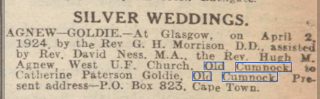
Cumnock Chronicle 1924


Goldie’s shop with canopy. It was extended round the corner into Hamilton Place.


The first of John & Margaret Goldie's surviving children was Catherine Paterson Goldie who was born in 1885 in Cumnock and died in 1964 at Port Elizabeth, Natal, South Africa. Catherine married the Rev. Hugh Agnew, Minister of The United Free Church, West, Cumnock, in Glasgow in 1924. Hugh had been ordained in 1922 and met Catherine through her family's close connections with the church. She was eight years older than Hugh. 

Silver Wedding Announcement 1949 - from Cumnock Connections Tree

Rev. Hugh Agnew served The United Free Church, West, from 1922 - 1930 and wrote 'The United Free Church West, Cumnock's History 1773 - 1923, published in 1923 by The Cumnock Chronicle Press. The box shaped church is the oldest church building left in Cumnock. After being a council storage facility it stood derelict for some years before being turned into The Box Cafe.


United Free Church West


Rev. Hugh Agnew sitting beside his father-in-law John Goldie


In 1929 Catherine and Hugh moved to Dundee where Hugh served as Minister at St. David's North Church until 1933 when they decided to emigrate to South Africa. His first charge in South Africa was St. George's Church, East London. 

The lives of the natives were most un-Christian. Not surprising conditions considering the hovels they were living in"
Rev. Hugh Agnew

Hugh took action. He managed to persuade the South African Minister of Finance to visit the place and the outcome was that he secured a £12 million project for the abolition of some of South Africa's most squalid slums. Medical schemes were set up and new locations, complete with water systems and other modern fittings, were built. His final charge was as Minister of St. Andrew's Presbyterian Church in Cape Town. This church had been formed by a detachment of Cameron Highlanders stationed at Cape Town in 1828 after financial grants had been received from the Dutch Reform Church and German Lutheran Church.

Catherine and Hugh did manage to visit Cumnock again a few times accompanied by their sons Hugh, who had been born in Cumnock and became a gynaecologist in South Africa and Ian, who had been born in Forfar, Scotland. Like Catherine, Rev. Hugh also died in South Africa.

Obituary 1/11/1957 - Dundee Obituary Books findmypast 1869 - 2018
Rev. Hugh M. Agnew, popular minister of St. David's North Church, Dundee from 1929-1933, when he went to South Africa, has died in East London, South Africa. He was 64. In South Africa he had been a minister in East London & Port Elizabeth and was General Secretary of  the Presbyterian Church of South Africa before re-entering the pastoral charge of St. Andrew's, Cape Town. He became Moderator of the Presbyterian Church of South Africa. While he held the position, four years ago he represented the South African Church at the General Assembly of the Church of Scotland. He revisited Dundee at that time. A friend of the late General Smuts, he instigated a £12 million project for the abolition of some of South Africa's most squalid slums.

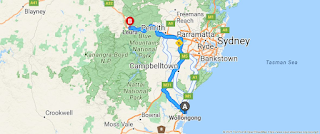
John and Margaret's second child was Robert Dunlop Goldie who was born in 1887 in Cumnock. He attended the Universities of Edinburgh and Cambridge and graduated M.B., Ch.B. and D.P.H., after which he began work as House Physician and House Surgeon at Glasgow Royal Infirmary. He emigrated to Australia in 1912 and commenced practice in Scarborough, Australia. At the beginning of WW1 in 1914 he enlisted with the Royal Army Medical Corps RAF and left with one of the first contingents of military reservists. He was promoted to Major and was awarded the French Honour, Medaille d’Honneur des Epidemies. On his return to Australia after WW1 he commenced practice at Corrimal, which is a suburb of Wollongong, New South Wales and in 1929 he commenced practice at Wollongong. During his very successful career in Australia Robert served as Commonwealth & State Medical Officers. Robert married Margaret (Daisy) Sellers in 1920 in Sydney and they went on to have four children. He died suddenly in 1952 while on holiday at Leura in the Blue Mountains in New South Wales. He named his house in Wollongong Glaisnock.


Leura and Wollongong, New South Wales


The third child of John & Margaret Goldie was Andrew who was born in 1889 in Cumnock and died in 1947 at 2 McCall Avenue, Cumnock. Andrew was the only one of their children to remain in Cumnock. He followed his father into the drapery trade and worked alongside him in the shop. Andrew married Janet Murdoch Gardiner in 1915 at Blythswood, Glasgow. Janet was born in 1881 in Auchinleck and died in 1965 at 2 McCall Avenue, Cumnock. 

Andrew and Janet had one son, John Dunlop Goldie who was born in 1920 in Cumnock. John, who was known as Jack, was a spitfire pilot in WW2. He was a sergeant with 542 Squadron, Royal Air Force Volunteers and was killed in action 26/1/1943 while on a photo recce sortie to Ghent, Belgium. Jack is buried at Eeklo Communal Cemetery, Belgium. He had only been married a short time when he was killed.

Fourth child John Kennedy Goldie (Kenny) was born in 1893 in Lugar Street, Cumnock. Kenny didn't keep good health and in 1913 he decided to emigrate to New Zealand in the hope that the milder climate would improve his condition. He managed to find employment as a warehouseman in Newmarket, a suburb of Auckland, New Zealand. WW1 was declared and in 1915 Kenny enlisted with the New Zealand Expeditionary Force, 2nd Battalion, Otago 9th Infantry Regiment. He was sent on active service to Egypt then France. His health worsened and in December 1916 he was admitted to hospital where he was diagnosed with tuberculosis. He was permanently discharged on 22nd December 1917.  The reason given was that he was no longer physically fit for war service because of a pre-enlistment disability aggravated by active service. On discharge he was recommended for a pension as his capacity for earning was only one half.

Records show that Kenny suffered from this condition pre-enlistment so it's surprising that he was accepted as a soldier. Tuberculosis caused breathing difficulties among other things. Chlorine gas was used for the first time by the Germans in 1915. When inhaled it caused soldiers to have difficulty breathing and sometimes death. Before gas masks were distributed soldiers would soak cloth in urine and hold it to their faces to prevent them from breathing in the gas. 

In 1919 Kenny married Lucy Mabel Booth but sadly he had a short life and died in 1925 in Auckland, New Zealand.

The youngest child of John and Margaret was Hugh Dunlop Goldie who was born in 1897 in The Square, Cumnock. Hugh served his apprenticeship as an engineer & fitter with George McCartney & Co. in Cumnock before enlisting with the Queen's Own Cameron Highlanders in 1914. He saw active service in Salonika where he contracted malarial and rheumatic fever. He was invalided out and returned to Cumnock where he was employed as a motor engineer by Messrs. H.D. Hunter. In 1922 he emigrated to Auckland, New Zealand to join his brother Kenny who had tuberculosis. Kenny died in 1925 and in 1935 Hugh left New Zealand for East London, South Africa, where his sister Catherine and her family lived. Unfortunately Hugh had a recurrence of the old rheumatic fever and died in 1939 at Frere Hospital, East London, South Africa.