About the project

Our project

Showing posts with label South Africa. Show all posts

Friday, 23 February 2024

Scholarly to a high degree - The story of the Clark family

 Scholarly to a high degree - The story of the Clark family

by Roberta McGee

William Clark and Elizabeth Thomson were married at Ayr Road, Cumnock on 7/6/1858. William was a tailor/clothier, Elizabeth was a domestic servant and both were born in Cumnock. William was a great believer in education and for many years he was a member of the School Board. They had ten children all born in Cumnock. He impressed upon them the importance of education and they in turn grew up to be a credit to their parents. Their uncle James Thomson, brother of their mother Elizabeth, was also highly intelligent. He was born on 3/5/1845 in Cumnock and died of consumption on 3/8/1876, aged 31 years old, in Badenweiler, South Germany. He was described in his obituaries as "Cumnock's most distinguished son" and "scholarly to a high degree".


Marble tablet erected over the family pew
in the Established Church of Cumnock


William and Elizabeth's firstborn child Adam Clark was born on 19/12/1857 at Ayr Road, Cumnock. He showed great promise and became a lawyer's clerk. Tragically, he was only 19 years old when he died on 30/4/1877 at Barrhill Road, Cumnock of acute meningitis. 

Five of their children became doctors - William, James, George, John and Jeannie.

William Clark, who was born in 1860, took his BSc. and M.A. in one session at University and for a time taught at Dollar Academy before making a career change into medicine and graduating M.D. at Glasgow University. He then moved to a medical practice in Dundonald, Ayrshire.

His brother George Clark, who was born in 1871, was studying medicine at Glasgow University when his health broke down. In 1898 he decided to leave Scotland and emigrate to South Africa in the hope that the climate there would improve his health. William decided to give up his practice in Dundonald and accompany him. George's health did improve and he was able to continue his studies there. Four years later in 1902 George, again accompanied by his brother William, returned to Scotland where George passed his final exams at Glasgow University. The brothers then returned to South Africa.

In South Africa George was affectionately called Dr. George. He practised in the town of Lady Frere and in 1906 he moved to Tarkastad, which has one of the healthiest climates in the world, where he died on 11/1/1913. He left a widow and two children. An Appreciation which appeared in "The Queenstown Review" on 18/1/1913 quoted a line from Shakespeare's 'Hamlet' to describe George -

"He was a man; take him for all in all, we shall not look upon his like again"

William continued to practise in South Africa but during WW1 he returned to London to take over his brother John's practice. After he retired he would visit South Africa regularly, sailing as ship's surgeon both ways. Dr. William, who never married, died on 29/2/1940 at 52 Airlie Street, Glasgow, the home of his sister Jessie.

Tuesday, 26 December 2023

The family of John Goldie, draper

 by Roberta McGee

John Goldie was born in 1858 in Catrine, the eldest son of Andrew Goldie, a weaving master with Messrs James Findlay & Co., Catrine and Agnes Kennedy, a power loom weaver. He served his time in the drapery trade in Glasgow where he formed a life-long friendship with The Hon. George Fowlds who became Minister of Education in New Zealand. In 1881 John took over the drapery business in Lugar Street, Cumnock from John Baird, the donor and founder of the Baird Institute. That same year, on 27th December, he married Margaret Dunlop in Catrine. 

John and Margaret soon became very much part of the community in Cumnock, being closely involved in the United Free Church, West and both becoming Justices of the Peace. Sixteen years later John acquired the house at the Hamilton Place corner of The Square and he transformed the building, adapting it to his rapidly extending business as a draper, ladies' & gent's outfitter etc. and there he remained, actively engaged, almost to his death. John died in 1939 at 9 Herdston Place, Cumnock. He was 80 years old. His wife Margaret died in 1951 in Cape Town, Cape Province, South Africa, the home of her daughter Catherine. She was 92 years old. 


Cumnock Chronicle 1924


Goldie’s shop with canopy. It was extended round the corner into Hamilton Place.


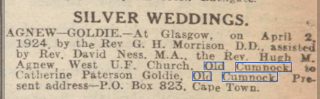
The first of John & Margaret Goldie's surviving children was Catherine Paterson Goldie who was born in 1885 in Cumnock and died in 1964 at Port Elizabeth, Natal, South Africa. Catherine married the Rev. Hugh Agnew, Minister of The United Free Church, West, Cumnock, in Glasgow in 1924. Hugh had been ordained in 1922 and met Catherine through her family's close connections with the church. She was eight years older than Hugh. 

Silver Wedding Announcement 1949 - from Cumnock Connections Tree

Rev. Hugh Agnew served The United Free Church, West, from 1922 - 1930 and wrote 'The United Free Church West, Cumnock's History 1773 - 1923, published in 1923 by The Cumnock Chronicle Press. The box shaped church is the oldest church building left in Cumnock. After being a council storage facility it stood derelict for some years before being turned into The Box Cafe.


United Free Church West


Rev. Hugh Agnew sitting beside his father-in-law John Goldie


In 1929 Catherine and Hugh moved to Dundee where Hugh served as Minister at St. David's North Church until 1933 when they decided to emigrate to South Africa. His first charge in South Africa was St. George's Church, East London. 

The lives of the natives were most un-Christian. Not surprising conditions considering the hovels they were living in"
Rev. Hugh Agnew

Hugh took action. He managed to persuade the South African Minister of Finance to visit the place and the outcome was that he secured a £12 million project for the abolition of some of South Africa's most squalid slums. Medical schemes were set up and new locations, complete with water systems and other modern fittings, were built. His final charge was as Minister of St. Andrew's Presbyterian Church in Cape Town. This church had been formed by a detachment of Cameron Highlanders stationed at Cape Town in 1828 after financial grants had been received from the Dutch Reform Church and German Lutheran Church.

Catherine and Hugh did manage to visit Cumnock again a few times accompanied by their sons Hugh, who had been born in Cumnock and became a gynaecologist in South Africa and Ian, who had been born in Forfar, Scotland. Like Catherine, Rev. Hugh also died in South Africa.

Obituary 1/11/1957 - Dundee Obituary Books findmypast 1869 - 2018
Rev. Hugh M. Agnew, popular minister of St. David's North Church, Dundee from 1929-1933, when he went to South Africa, has died in East London, South Africa. He was 64. In South Africa he had been a minister in East London & Port Elizabeth and was General Secretary of  the Presbyterian Church of South Africa before re-entering the pastoral charge of St. Andrew's, Cape Town. He became Moderator of the Presbyterian Church of South Africa. While he held the position, four years ago he represented the South African Church at the General Assembly of the Church of Scotland. He revisited Dundee at that time. A friend of the late General Smuts, he instigated a £12 million project for the abolition of some of South Africa's most squalid slums.

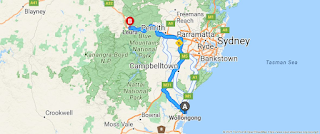
John and Margaret's second child was Robert Dunlop Goldie who was born in 1887 in Cumnock. He attended the Universities of Edinburgh and Cambridge and graduated M.B., Ch.B. and D.P.H., after which he began work as House Physician and House Surgeon at Glasgow Royal Infirmary. He emigrated to Australia in 1912 and commenced practice in Scarborough, Australia. At the beginning of WW1 in 1914 he enlisted with the Royal Army Medical Corps RAF and left with one of the first contingents of military reservists. He was promoted to Major and was awarded the French Honour, Medaille d’Honneur des Epidemies. On his return to Australia after WW1 he commenced practice at Corrimal, which is a suburb of Wollongong, New South Wales and in 1929 he commenced practice at Wollongong. During his very successful career in Australia Robert served as Commonwealth & State Medical Officers. Robert married Margaret (Daisy) Sellers in 1920 in Sydney and they went on to have four children. He died suddenly in 1952 while on holiday at Leura in the Blue Mountains in New South Wales. He named his house in Wollongong Glaisnock.


Leura and Wollongong, New South Wales


The third child of John & Margaret Goldie was Andrew who was born in 1889 in Cumnock and died in 1947 at 2 McCall Avenue, Cumnock. Andrew was the only one of their children to remain in Cumnock. He followed his father into the drapery trade and worked alongside him in the shop. Andrew married Janet Murdoch Gardiner in 1915 at Blythswood, Glasgow. Janet was born in 1881 in Auchinleck and died in 1965 at 2 McCall Avenue, Cumnock. 

Andrew and Janet had one son, John Dunlop Goldie who was born in 1920 in Cumnock. John, who was known as Jack, was a spitfire pilot in WW2. He was a sergeant with 542 Squadron, Royal Air Force Volunteers and was killed in action 26/1/1943 while on a photo recce sortie to Ghent, Belgium. Jack is buried at Eeklo Communal Cemetery, Belgium. He had only been married a short time when he was killed.

Fourth child John Kennedy Goldie (Kenny) was born in 1893 in Lugar Street, Cumnock. Kenny didn't keep good health and in 1913 he decided to emigrate to New Zealand in the hope that the milder climate would improve his condition. He managed to find employment as a warehouseman in Newmarket, a suburb of Auckland, New Zealand. WW1 was declared and in 1915 Kenny enlisted with the New Zealand Expeditionary Force, 2nd Battalion, Otago 9th Infantry Regiment. He was sent on active service to Egypt then France. His health worsened and in December 1916 he was admitted to hospital where he was diagnosed with tuberculosis. He was permanently discharged on 22nd December 1917.  The reason given was that he was no longer physically fit for war service because of a pre-enlistment disability aggravated by active service. On discharge he was recommended for a pension as his capacity for earning was only one half.

Records show that Kenny suffered from this condition pre-enlistment so it's surprising that he was accepted as a soldier. Tuberculosis caused breathing difficulties among other things. Chlorine gas was used for the first time by the Germans in 1915. When inhaled it caused soldiers to have difficulty breathing and sometimes death. Before gas masks were distributed soldiers would soak cloth in urine and hold it to their faces to prevent them from breathing in the gas. 

In 1919 Kenny married Lucy Mabel Booth but sadly he had a short life and died in 1925 in Auckland, New Zealand.

The youngest child of John and Margaret was Hugh Dunlop Goldie who was born in 1897 in The Square, Cumnock. Hugh served his apprenticeship as an engineer & fitter with George McCartney & Co. in Cumnock before enlisting with the Queen's Own Cameron Highlanders in 1914. He saw active service in Salonika where he contracted malarial and rheumatic fever. He was invalided out and returned to Cumnock where he was employed as a motor engineer by Messrs. H.D. Hunter. In 1922 he emigrated to Auckland, New Zealand to join his brother Kenny who had tuberculosis. Kenny died in 1925 and in 1935 Hugh left New Zealand for East London, South Africa, where his sister Catherine and her family lived. Unfortunately Hugh had a recurrence of the old rheumatic fever and died in 1939 at Frere Hospital, East London, South Africa.


Friday, 22 December 2023

Robert Smith, Ochiltree to Eastern Cape Province

By Elaine Corbett
Robert Smith  was a farmer’s son from Whitehill Farm, Ochiltree.
Follow this link to the farm post for Whitehill on our blog Ploughing Up Our Past.

Robert was my 2nd great grand-uncle, brother of my great, great grandfather, David Smith.

He was the third son of Robert Smith and Jane Guthrie born in 1835, and must have been recognised as being a bright lad and encouraged to pursue his studies. The remaining sons all stayed farming. 

The 1851 census finds him in Ochiltree village with, (we think) his great-aunt, Elizabeth Wallace so it is evident he was sent away from the distraction of his siblings to get on with his book learning.
In 1861 he was living in Aberdeenshire as a teacher, and in 1862 he married Margaret Anderson, in Binns Farm, Urquhart. Margaret’s family were interesting, as her father was a farmer and ship owner. Her uncle was a sea captain before he too bought into a shipping company and settled in Glasgow with his Danish wife.
The 1871 census sadly, shows that Robert had gained two sons, William and Robert, but Margaret had died from complications of childbirth. His occupation was now Bank Agent. 
In 1872 he married Mary Mather and they set up home together in Union Street, Aberdeen. They had four children before Mary died in 1888 from Tuberculosis. 
Despite his personal tragedies, Robert’s career seems to have been doing well, and by the 1891 census, he had decided to emigrate to King William’s Town, East Cape Province, South Africa and had become the manager of the Bank of South Africa there. The children were staying with family getting ready to join their father and begin their new life.
The younger boys David Guthrie Smith, and John Ogilvie Smith, and daughter Jessie MacLean Smith were staying with Mary’s sister in Glasgow, while Mather, the oldest of Mary’s children was with Uncle Hugh at Whitehill Farm. The sons from his first marriage seem to have left home and were building their own lives. Their names were Robert Smith, and William Anderson Smith.
Robert stayed in Scotland and qualified as a doctor, and found a medical practice in Assam, India, but unfortunately died there aged just 30.
William Anderson Smith was studying Arts in Aberdeen University, but no trace after that in UK records, until the very last clipping posted here.
There was also an adopted daughter called Elizabeth Anderson, but I can’t find any trace of her, or even who her mother and father might have been.
Of the remaining family, it seems they had an exciting life in South Africa.

The Smith family had not long been in South Africa before the Second Boer War began. Although a relatively short war, from 1899 to 1903  it was quite brutal. Much of it was conducted under guerilla tactics, sieges, and was the first war we saw mention of concentration camps. It was fought using cavalry swords, rifles and bayonets, and cannon. All three of Robert’s sons who were with him immediately signed up to fight.
Mather joined the 1st Battalion, Imperial Light Horse and his record shows he earned four clasps to his medal for seeing action at the relief of  Mafeking, the Transvaal clasp, the Relief of Ladysmith, and Tugela Heights.
He was wounded at Acton Homes 19th January 1900, where 40 Boers were captured, recovered from his wounds then returned to service. He was finally discharged from service 12th October 1900.
When he was staying with his Uncle, before going out to Eastern Cape, he had been studying engineering. When he married Nellie Sweeten, a Cumbrian girl from Penrith in 1911, he was described as being from the Worcester Gold Mining Company, Barberton, so it seems his engineering studies had come to fruition.

Cumberland and North Westmorland Herald 17th June 1911

Arthur Sweeten was publisher of a newspaper in Penrith, and one of his sons was out in South Africa, so perhaps Nellie met Mather in South Africa.