About the project

Our project

Thursday, 18 January 2024

George Urquhart - Civil Engineer

 by Roberta McGee

Margaret Mackervail, the fourth child of shoemaker Robert Mackervail and Lillias Bryden, was born in 1823 in Cumnock. Robert and Lillias had six children. Margaret's siblings seemed to be content to spend a settled life in Cumnock but for Margaret life turned out a little bit different. 

She met James Urquhart, who was a railway contractor, and they married in 1846 in Old Cumnock. After their marriage they lodged in Main Street, Auchinleck. James's brother William, who was a blacksmith, lived in Main Street so perhaps they lodged with him. Four of their children were born in Auchinleck, James, Lillias, Janet-Jessie and Robert.

By 1861 the family had moved to Lochans Village, Inch, Wigtownshire and two more children had been born, George and Alexander. In 1871 the family were living in Springbank, Neilston with the addition of another two children, William and Margaret. The 1881 census shows the family at 44 Apsley Place, Glasgow Gorbals. James is now a contractor (waterworks). James sadly died in Glasgow in 1889.

So, in total, James and Margaret had eight children. Like Margaret's siblings, all of their children, with one exception, were content to live their lives in Scotland. George was the exception.

Monday, 15 January 2024

Cumnock diaspora map

To add your town, log in to your google account, find your town on the map, Add marker ( symbol next to the hand in bar at top of page, type the name of your town, add your name if you want to. 

https://www.google.com/maps/d/u/0/edit?mid=1bFE_Wrg366QXTYrEzR8jzx_yQXC8F2Q&ll=2.7579562403534084%2C0&z=2&fbclid=IwAR2JenRFnCcyup9PUkKq4tixfbBunjN4wA6ERJ-A8GZ-feqoa_7Dw5hi6Pg

Drapers

By Kay McMeekin

When doing our recent farm research,  we noticed that many farmers sons were becoming drapers particularly in England.

There were travelling drapers as well as shop workers.

A draper sold cloth and was often an outfitter as well. 

The definition of “Scotch Draper” was someone who sold goods door to door with payments to be made in instalments. They were also known as travelling drapers and credit drapers. (from https://www.cottontown.org/Other%20Industry/Pages/Retail-Trade.aspx)


Dumfries and Galloway Standard - Wednesday 17 January 1877


Ayr Advertiser 1883

John Weir 1836-1890 of Sykeside farm Cumnock was a draper in Rotherham, Yorkshire

William Howat of Polquhirter and brothers David and James were drapers in Preston, Lancashire in 1881.

Three Baird of Watson sons went to Lancashire, and Robert Baird's brothers-in-law John and Matthew McKerrow were also drapers in Lancashire.

Another related line of McKerrows were drapers William McKerrow in Wigan and Ormskirk.


Banffshire Herald - Saturday 16 July 1898


This article from the Western Mail - Wednesday 02 April 1930 throws some light on the situation.

DRAPERY TRADE. 
HOW TO ATTRACT THE BEST RECRUITS. 
Sir Sydney Skinner, president of the Drapers' Chamber of Trade, presiding at the annual meeting of the chamber at the Cordwainers' hall, Cannon Street, on Tuesday, said stressing the need for attracting the right sort of ability to the drapery trade, 
"In the old days we used to get the sons and daughters of farmers. A farmer always used to put a boy or girl into the drapery trade. Some of the must successful men and women we have in our business to-day are farmers' sons and daughters. We do not get so many now, and I believe this is largely due to the fact that mothers to-day have a fear of sending their daughters to the big towns. I myself am reinstating the 'living-in' system, because I am going to try and re-attract that type of boy and girl. I ant not going to let them come to London and be at the mercy of some woman who runs a lodging-house and will fleece them. It is because the 'living in' system has been abolished that many mothers are no longer sending us their girls. The drapery trade gives a boy or girl coming up from the country a wonderful opportunity for progress such as very few other trades or professions will offer them."

Wednesday, 10 January 2024

Niagara Falls Reunions


by Roberta McGee

 The Cumnock Chronicle Parish Reunions at Niagara Falls

The New History Of Cumnock - John Strawhorn - p184
In the 20th century two new floods of emigration, one in the first decade, the other after 1945, took more local people overseas. The Cumnock Chronicle has had a close and varied association with the emigration movement. In 1885 James P. Ballantine added to his printing and stationery business that of shipping and emigration agent. In 1955 Duncan Ballantine started an Overseas Readers' Column in the Chronicle and with the world his parish initiated that year a Cumnock Chronicle Parish reunion at Niagara Falls which became a regular annual event with sometimes as many as 500 guests with a Cumnock district connection.

The following article was reported in The Cumnock Chronicle on 4/8/2023
A document from the 1950s hidden in a dresser has revealed details of reunions held by former residents in the Cumnock area who emigrated to the USA and Canada.

The document, entitled 'Chronicle of the Byelaws of the Cumnock Chronicle Parish Reunion'  was found by Donovan Moore, from the U.S. He revealed: "My great-grandmother moved to the United States from Scotland and I have recently inherited a few of her old dressers. My great-grandmother's name was Martha Gildea Hunter. The document states: "On Sunday, July 30, 1955, a group consisting of 75 loyal Scots held a reunion in the Queen Victoria Park, Niagara Falls, Ontario in honour of Mr. & Mrs. D. Maclean Ballantyne - Mr Ballantyne being editor and publisher of the Cumnock Chronicle, a weekly newspaper published in the south Ayrshire district of Scotland.

The people present on that occasion were drawn from both sides of the Canadian and American borders, but originally emigrated from the various home towns in said circulation area.

Since the gathering became such an unqualified social event, it was unanimously decided to set aside the last week in July of each year for similar purposes and that the current president Mr. James Thomson and secretary David Cunningham be instructed to draw up a set of bylaws covering all matters relevant to same.

The undernoted was presented at the second annual reunion in the Fox Head Hotel on 28 July 1956 and was adopted by acclamation

It then sets out byelaws, which confirmed that Mr. Ballantyne would become permanent honorary president. It also states that Membership would be open to any adult or a friend originating from any of the home towns where the Cumnock Chronicle reaches, Canadian or American. Descendants of parents from the area were also eligible for membership.  

Original Document


The aforementioned Duncan Maclean Ballantine was born at 51 Glaisnock Street, Cumnock on 15/11/1901 and died at Torrance Lodge Nursing Home, Hurlford in 1993. He was the Cumnock Chronicle Editor and Publisher.

The father of Duncan Maclean Ballantine was James Paterson Ballantine who was born on 11/7/1863 at Townhead, Cumnock.
 
  Extract from The Cumnock Chronicle 1924
James Paterson Ballantine, the owner of the Cumnock Chronicle, was a printer-compositor, shipping & emigration agent. In 1885 he was first licenced as agent for The State Shipping Line and in subsequent years he was appointed agent for the principal shipping companies sailing from this country to all parts of the world. He conducted an extensive emigration business, sending young farm hands and domestics particularly to the Dominion of Canada and to Australia and New Zealand. At one time he was responsible for supplying almost the entire house staff of Scotch assistants to the Guelph Sanatorium in Ontario, when many years later, the writer, when visiting this institution in Guelph, met people whom Mr. Ballantine had sent out a generation or more earlier, all of them now in responsible positions. In connection with the emigration work, he paid two extensive visits to Canada, and as a result of his experiences on these occasions, he wrote and published a booklet on 'The Golden West' which was intended as a guide to prospective emigrants in the great farm and orchard lands of Nova Scotia, Quebec, Ontario, Manitoba, Saskatchewan, Alberta and British Columbia.
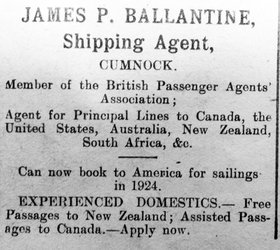

Cumnock Chronicle 1924


Martha Gildea Hunter, to whom the document belonged, was born 26/12/1917 at Tower Street, Cumnock. Her father was Joseph Hunter, who was born in Portobello, and her mother was Martha Gildea, who was born in Dumbarton where they were married in 1907. Her grandfather was 'Pottery Joe' who worked at the nearby Cumnock Pottery.

Cumnock Connections - Family Tree (tribalpages.com)

The New History of Cumnock - John Strawhorn - p91
Joe's Brig was named after Joe Hunter ('Pottery Joe') who for many years entertained the Heckler's meetings with his wit, campaigning for a bridge to replace the stepping stones at the Greenholm.


Joe’s Brig
      

On 17/7/1926 Martha Gildea Hunter's father Joseph sailed from Glasgow on the 'Caledonia', arriving in Philadelphia on 26/7/1926. His two oldest sons soon followed with James arriving in New York on 13/8/1928 and Joseph arriving on 2/9/1928. They were to join their father in Syracuse, which is in Onondaga County, New York. They were all reunited in May the following year when mother Martha and their siblings Alexander, Edward, Martha, Robert and Thomas arrived in New York aboard the 'Cameronia'. Another daughter Janet was born in New York in 1933.

Martha Gildea Hunter married Patrick J. Long and died 17/3/2010 in Syracuse, Onondaga, New York. Read more about Martha's life.

The Niagara Falls Reunions, which took place from 1955 onwards, were hugely popular for ex Cumnock folks. Did any of our members or their families ever attend them or perhaps have photographs they would like to share? We would love to see them.


Monday, 8 January 2024

Footballers

By Kay McMeekin

Footballers move around a lot.

A lot of local players went to Preston North End in Lancashire, England which was founded in 1880.

John Graham  payed for Preston North End in about 1890 and his brother William Graham played for Preston North End and Newcastle United

 Thomas McCall Smith  Thomas Hamilton also went to Preston North End in the 1920s and 1930s.  They all returned to their roots in Ayrshire.

David Reid McCulley 1895-1962 a grocer in Cumnock played for Ayr United but his professional career was cut short by an ankle injury.

Davy Wells from New Cumnock played for Auchinleck Talbot then Ayr United in 1970 aged 17.

a young Bill Shankly

Bill Shankly born in Glenbuck in 1913 is still a household name!  A memorial in the old Glenbuck on the site of the Shankly house attracts Liverpool fans on pilgrimages from all over.


As a player: Cronberry Eglinton 1931-32,Carlisle United 1932-33,Preston North End 1933-49, Liverpool 1942 as guest and Scotland 1938-39 (5 caps)

As a manager: Carlisle United 1949-51, Grimsby Town 1951-54, Workington 1954-55, Huddersfield Town 1956-59, Liverpool 1 Dec 1959 - 12 Jul 1974

Bill died in Liverpool in 1981.

His brother James B Shankly played for Portsmouth,Sheffield United and Carlisle

John Shankly played for Glenbuck Cherrypickers, Greenock Morton, Carlisle United, Luton Town, Portsmouth, Alloa, Kings Park, Larne

David Thompson McCartney (26 December 1875 – 8 December 1949) was a Scottish professional footballer, best remembered for his time as a centre half in the Southern League with Northampton Town and Watford. He also played in the Football League for Glossop and Chelsea. When he retired, the family emigrated to Australia on the Samaris arriving November 1910. He went back to mining at Aberdare South Colliery.

Andrew Johnstone McCall born Cumnock 1908 played for Cumnock Townhead Thistle, Ayr United, St johnstone in 1935 and Huddersfield in 1939 and after. a few months to Nottingham Forrest. He rejoined Ayr United in 1940. He played for Clyde then Dundee He was manager of Dundee 1958-9.

Ayr United, Andy is front 2nd from right

Eric Caldow - professional footballer and Scotland internationalist, was born 14 May 1934 and raised in Skerrington, Cumnock and attended Cumnock Academy. Eric first played for the Cumnock Academy Football Team at right-back. His first Junior Football Team was Muirkirk but he was soon signed by Glasgow Rangers and played for them until 1964.
Eric was capped for Scotland 40 times from 1957 to 1963. His first cap was on 6th April 1957 against England at Wembley in front of a crowd of 97,520 where Scotland lost 2-1. He played for Scotland on the 6th April 1963 against England at Wembley - where he broke his leg. 
Eric received a civic reception in 1961 because of his fame as a Scottish internationalist. He managed Cumnock Juniors for a short time in 1978.
After leaving Rangers Caldow then played for one season with Stirling Albion before moving south to become player-manager of Corby Town in 1967. He returned to his native Ayrshire to become manager of Junior side Hurlford United in 1970 and three years later was appointed manager of Scottish League side Stranraer. Caldow left Stair Park in 1975 and his last involvement with football was as a scout for Queens Park Rangers.
Caldow was inducted to the Scottish Football Hall of Fame in 2007. He died in 2019.

George Burley, born in Cumnock in 1956, had a distinguished career as a player and manager. He joined Ipswich Town in 1972. He made 18 appearances playing for Scotland and was the Scotland manager 2008-9. 
A relation of his Craig Burley born 1971 was also a successful footballer  playing for Chelsea, Celtic and Preston North End amongst others. He is now a sports pundit for an American TV channel EPSN.

The McCartney brothers David and John went to Australia.


Friday, 5 January 2024

Hadden family from Ireland to Ayrshire to USA

By Joanne Ferguson

A family history of 200 years from Ireland to Ayrshire to USA.

Track them on the Cumnock Connections tree Mary Jane Bruce later Hadden then Coulter

Bruces from Country Antrim in Ireland. They moved to Kilwinning in Ayrshire about 1840

Alexander Bruce was born in County Antrim, Ireland, about 1790.  He married Catherine Pollock.  They had five children: Alexander Bruce (1812-1860); Samuel Bruce (1816-1858); Martha Bruce (1820-??); Stewart Bruce (1820 -1893); and Hugh Bruce (1829-1870).

Alexander Bruce married Mary Dougherty.  They had three children: Mary Jane Bruce (1837-1918); John Bruce (1839-??); Martha Bruce (1842-1930); and Alexander Bruce (1849-1925).  After Mary Dougherty’s death (about 1850), Alexander married Janet Grier in 1851 in Kilwinning.  

Haddens in Cumnock, Ayrshire

John Hadden was also born in Ireland in 1839.  He was the son of John Hadden and Janet Jenkins. Little else is known about him in Ireland. He is listed as a miner and as a boarder at High Row in Lugar in 1861.  On June 12, 1863, he married Mary Jane Bruce in Auchinleck.  They had seven children: James Hadden (1864-1916); John Bruce Hadden (1865-1925); Mary Bruce Hadden (1866-1947); Jane (Jeannette) Hadden (1868-1958); Alexander Hadden (1870-1907); Samuel Hadden (1872-1913); and Martha Hadden (1874-1953).

On December 7, 1873, John Hadden died, leaving Mary with six children and nine months pregnant with their seventh child, Martha.

Coulters in Cumnock

Widowed Mary married William J. Coulter about 1875 in Cumnock, although no marriage certificate can be found.  They had four children: William Coulter (1876-1929); Andrew Coulter (1877-1939); Esther Black Coulter (1879-1930); and Bruce Lee Coulter (1882-1921).

Mills from Kilwinning to Scranton

Mary also had another son prior to her first marriage by an unknown partner. That son was Hugh Bruce (1860-??).  Hugh left Scotland with David and Margaret Mills, who had adopted him.  In the 1870 US census, Hugh is listed as Hugh Mills, living with Margaret and David in Scranton, Pennsylvania, and attending school.  Margaret Mills died in 1877 and David Mills died in 1884, both in Scranton.  There were no more traces of Hugh Bruce.

Her sons James, John, and Alexander Hadden had already left for Pennsylvania around 1888, although no immigration records can be found.

The Scots did not appear to be leaving the British Isles for religious reasons.  The Scots were the first group to immigrate to America primarily for economic opportunity.

Mary Jane Bruce Hadden Coulter boarded the Spain in Edinburgh and arrived in New York on February 17, 1887.  She was accompanied by the following children:  Jennette Hadden, Samuel Hadden, Martha Hadden, William Coulter, Andrew Coulter, Alice Coulter (Esther), and Bruce Coulter.  

Wednesday, 3 January 2024

Van Cootens from Demerara to Cumnock to Australia

by Roberta McGee

Jane, known as Jean, McGlashan was born in Old Cumnock in 1798, the daughter of Alexander McGlashan and Abigail Patrick. When she was 20 years old she found herself pregnant, the father of her child being Hilbert Van Cooten, and she appeared before the Kirk Session on 23rd April 1818.

Kirk Session Minutes
Cumnock 23 April 1818
Constituted with prayer
Present - The Moderator and all the Elders

When Jean McGlashan in the village appeared voluntarily confessing she had brought forth a Child in fornication and accusing Hilbert Van Cooten lately in Cumnock now a medical student in Glasgow as the father of it from whom a letter of acknowledgement to the session was produced. The Session having considered the same agree to take her on discipline according to her request and she was therefore rebuked admonished to repentance and having paid a Guinea to the poor was absolved from the scandal.  Concluded with prayer.

The child, who was born 5th March 1818 in Old Cumnock to Jean McGlashan and Hilbert Van Cooten, was named Jean Van Cooten. Jean and Hilbert eventually married nearly three years later on 8th January 1821 at Gorbals, Glasgow.


Perhaps the reason that Hilbert was in Cumnock was that he met Jean's older brother Gilbert McGlashan who was a medical student at the same time. Gilbert was studying at Edinburgh and Hilbert at Glasgow.
(Thanks to Kay for finding this information)

So who was this medical student Hilbert Van Cooten who arrived in Cumnock and captured Jean McGlashan's heart?